Tiếng Việt
 中文 (中国)
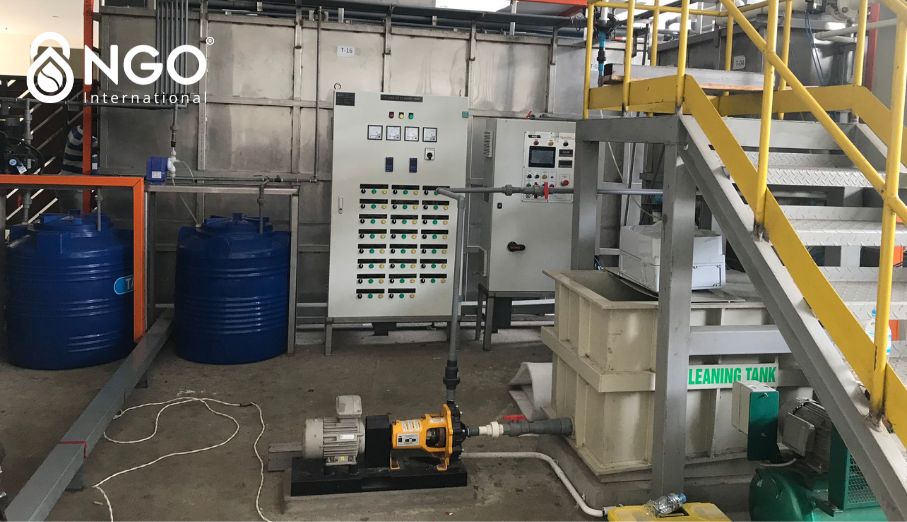
For facilities discharging less than 200 m³ of wastewater a day, the sticking point is usually not the technology but space, time and operating staff. A prefabricated containerised integrated module solves all three when the right configuration is chosen. NGO International Co., Ltd (NGO International), an environmental company founded in 2016 in Hanoi, designs and manufactures integrated wastewater treatment modules, including a line that uses MBR membranes. A company in Vinh Phuc (now part of Phu Tho province) has used NGO’s mobile integrated module since 2018.
Overview of small-scale wastewater treatment
Sources below 200 m³/day include small and medium-sized workshops, factories in industrial parks, buildings, small residential areas and service facilities. Small scale does not mean lighter requirements: the effluent must still meet the applicable technical regulation or the park’s connection limits, while many facilities have no dedicated environmental staff.
The difficulties lie in three areas. Flow fluctuates sharply by the hour, so the system needs an equalisation tank or must be able to handle peak loads. Space is often tight, especially in rented workshops or retrofit projects. And time: building concrete tanks takes months, while businesses need a compliant system soon.
When choosing a solution, consider the measured flow and quality, the available space, the deadline for putting the system into operation, operating staff and the possibility of relocation or expansion. For businesses renting factory space on short-term leases, being able to dismantle and move the entire system is a significant advantage.
NGO International’s capabilities in integrated wastewater treatment modules
The mobile integrated module designed by NGO is fabricated in the workshop as a steel container, transported by truck and installed on site with no civil construction required. According to the design specifications, the biomass concentration (MLSS) is maintained at 5,000–7,000 mg/L, tank volume is about 50% smaller than with activated sludge, and the MBR membranes have a service life of 7–10 years. As a result, the module saves up to 50% of tank area compared with conventional technology. It is one of NGO’s construction-free wastewater treatment options.
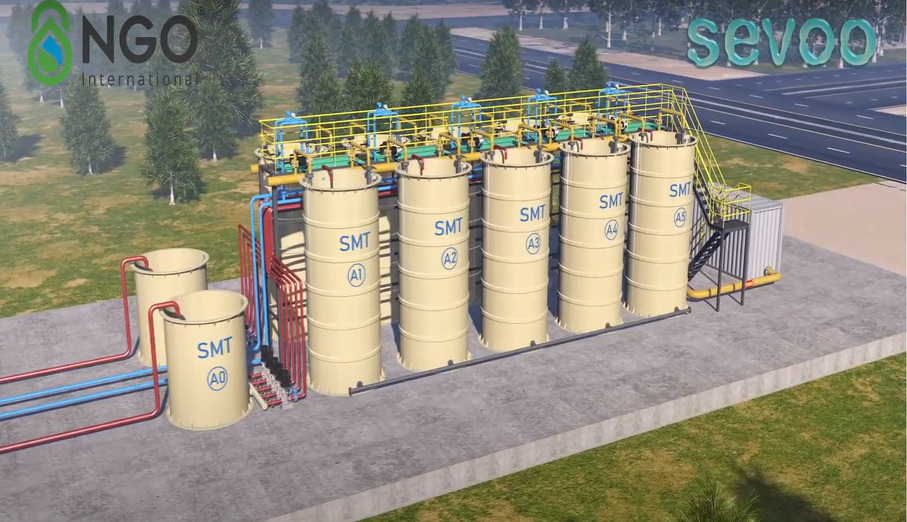
Beyond fabrication, the company provides operating guidance and supports effluent quality control and troubleshooting throughout the period of use through its operation consulting service. For larger capacities, the company offers the SMC module line, which uses flat-sheet MBR membranes, with a capacity of 50–8,000 m³/day, PLC control and remote monitoring support.
Featured projects by NGO International
The section below is compiled from customer feedback and the video at the top of this article, which records the steps from fabricating the housing and installing the equipment to transporting the module by truck; the company is not named.
Integrated wastewater treatment module for a company in Vinh Phuc (now part of Phu Tho)
| Location | Vinh Phuc (now part of Phu Tho) |
|---|---|
| Product | Mobile integrated module |
| Year | Supplied since 2018 |
| Operational support | More than 4 years |
- The challenge
The company needed a compact, space-saving system that would keep its effluent within the requirements of the management board of the industrial park where the plant is located.
- NGO’s solution
NGO supplied a mobile integrated wastewater treatment module, prefabricated so that the plant did not have to build tanks.
- NGO’s role
NGO International was the module supplier and stayed with the client for more than four years afterwards: consulting, operational support and effluent quality control.
- Results / value delivered
According to the company’s feedback, the effluent meets the requirements of the industrial park management board. The feedback is published in the “What our clients say” section of our Projects page (in Vietnamese).
Containerised MBR module: fabricated in the workshop, installed on site
| Format | Steel container fabricated in the workshop |
|---|---|
| Capacity | Below 200 m³/day |
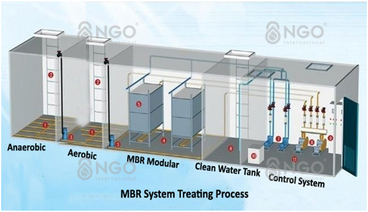
| Components | XMBR tank, air distribution assembly, control panel |
| Installation | Transported by truck, connected on site |
- The challenge
Many facilities have neither the space nor the time to build tanks, yet still need a compliant system within a short time.
- NGO’s solution
The module housing is welded and the equipment installed in the workshop, including the XMBR membrane tank, the air distribution assembly at the bottom and the electrical control panel. On site, the remaining work is mainly placing the module, connecting the pipework and power, then starting operation.
- NGO’s role
NGO International designed and fabricated the module in its workshop and transported it to the site.
- Results / value delivered
With no civil construction, the system goes into operation faster than a station built on site, and the module can be relocated when the business moves.
Wastewater treatment technologies commonly used at small scale
Below 200 m³/day, the three most widely used groups of biological technology are activated sludge (AO, AAO), MBBR and MBR. Activated sludge and MBBR are cheaper when there is land to build tanks, but they need settling tanks and a large footprint.
MBR combines activated sludge with MF/UF membranes with pores of about 0.1–0.4 µm, so the water leaving the membrane contains almost no suspended sludge and no settling tank is needed. Because it maintains a high biomass concentration, an MBR tank is significantly smaller – a major advantage inside a container. On the other hand, capital and energy costs are higher, and the membranes must be cleaned following the correct procedure to avoid clogging. Our article on MBR membranes gives a more detailed comparison.
For wastewater containing oil and grease or detergents, a grease separation and equalisation step should be installed upstream of the module to protect the membranes.
Small-scale wastewater treatment in Vinh Phuc (now part of Phu Tho)
The former Vinh Phuc, Phu Tho and Hoa Binh provinces were merged into Phu Tho province in the 2025 administrative reorganisation. The former Vinh Phuc area lies right next to Hanoi, so site surveys and technical support from NGO’s head office in Hanoi are quite convenient.
The former Vinh Phuc province has many industrial parks with component, mechanical engineering and supporting-industry companies. For companies in an industrial park, the decisive requirement is the effluent quality set by the park management board, as in the project above. It is advisable to obtain written confirmation of this requirement before finalising the module’s technology and capacity.
Beyond the former Vinh Phuc province, NGO undertakes surveys, supply and operational support of integrated modules for small-scale workshops and factories in the Northern Vietnam industrial parks below; the modules are transported by truck, so they can also be installed in localities far from our head office.
Where we work: integrated wastewater treatment modules
Northern Vietnam: Vinh Phuc (now part of Phu Tho), Bac Giang (now part of Bac Ninh), Hung Yen, Hai Duong (now part of Hai Phong)
Why choose a provider with hands-on experience?
Small systems are easily underestimated: low price, standard equipment, any contractor will take the job. Yet it is precisely at this scale that post-investment risk is high, because there is no engineer on duty. The contract should clearly state the module’s specific configuration, the conditions and cost of membrane replacement, who provides support when the effluent exceeds the limits, and how long it takes them to arrive on site.
Experience with similar projects also matters: small-scale wastewater often contains oil and grease, detergents or batch discharges, none of which appear in the specification sheet. A supplier that has followed its modules over many years can anticipate them.
Frequently asked questions
It suits facilities with less than 200 m³/day of wastewater that need fast installation, have no space to build tanks or want the option to relocate. Larger capacities can use the SMC module line.
NGO International has supplied a mobile integrated wastewater treatment module to a company in the former Vinh Phuc province, now part of Phu Tho, since 2018, and provided operational support for more than four years afterwards.
NGO’s integrated modules have been in use in Vinh Phuc (now part of Phu Tho) since 2018. NGO undertakes surveys, supply and operational support of modules for facilities in Bac Giang (now part of Bac Ninh), Hung Yen and Hai Duong (now part of Hai Phong).
The module is fabricated and fitted with equipment in the workshop, then transported to the facility, with no tanks to build. It goes into operation sooner and can be relocated when needed.
MBR maintains a high biomass concentration, so the tank is smaller, with volume reduced by about 50% according to the design specifications, and the membrane replaces the settling tank, so the effluent is free of sludge. In return, membrane capital and operating costs are higher.
The design service life of the membranes is 7–10 years, depending on wastewater quality and on cleaning the membranes following the correct procedure.
Measured wastewater flow and quality data, the module location, power supply, discharge point and the effluent requirements of the regulatory authority or the industrial park management board.
Conclusion
For wastewater volumes below 200 m³/day, a prefabricated module gives a facility a compliant system without building tanks or setting aside much space. Long-term performance still depends on a configuration matched to the actual wastewater and on the provider’s support after installation.
NGO International’s integrated module has been in use in the former Vinh Phuc province (now part of Phu Tho) since 2018, with operational support for more than four years after that. Facilities considering a fast-install option can send their flow and available space so that NGO can propose a module configuration that fits.
Contact NGO International