Tiếng Việt
 中文 (中国)


Under the Law on Environmental Protection 2020 and related guiding documents, wastewater from urban drainage systems, industrial parks and concentrated rural residential areas discharged into a receiving water body must meet the national environmental technical regulations of the Ministry of Natural Resources and Environment.
In particular, wastewater from factories inside an industrial park that is discharged into the park’s centralised drainage system must comply with the current regulations on industrial park environmental management; the regulation currently in force is QCVN 40:2025/BTNMT (in Vietnamese), under which the lowest standard level is Class B.
Businesses located outside industrial parks and clusters must treat wastewater to the standard of QCVN 14:2025/BTNMT, Column C, B or A.
I. In domestic wastewater treatment, which parameters do businesses most often exceed?
Depending on whether QCVN 14 or QCVN 40 applies, the main parameters to be treated include COD, BOD, TSS (total suspended solids), ammonium, TN (total nitrogen) and TP (total phosphorus). The biggest challenge lies not only in treating COD, BOD or TSS, but in thoroughly removing ammonium (NH₄⁺) and total nitrogen (TN) – two “stubborn” parameters and the leading reason why many systems fail. A project that meets the limits for ammonium and TN will naturally meet the remaining parameters as well.
II. Why do businesses find it difficult to choose among today’s wastewater treatment technologies?
- Solutions need a large area or are too expensive;
- Many small wastewater treatment contractors are cheap but their quality is not assured, and they cannot provide good after-sales service;
- They invest in a system but worry about how to operate it;
- They do not know the technologies well enough to compare them and choose a quality contractor;
- They have invested in a wastewater treatment system before but the treatment quality was poor, so they lack trust in contractors;
- Pressure from the local authorities.
III. What is SmartB?
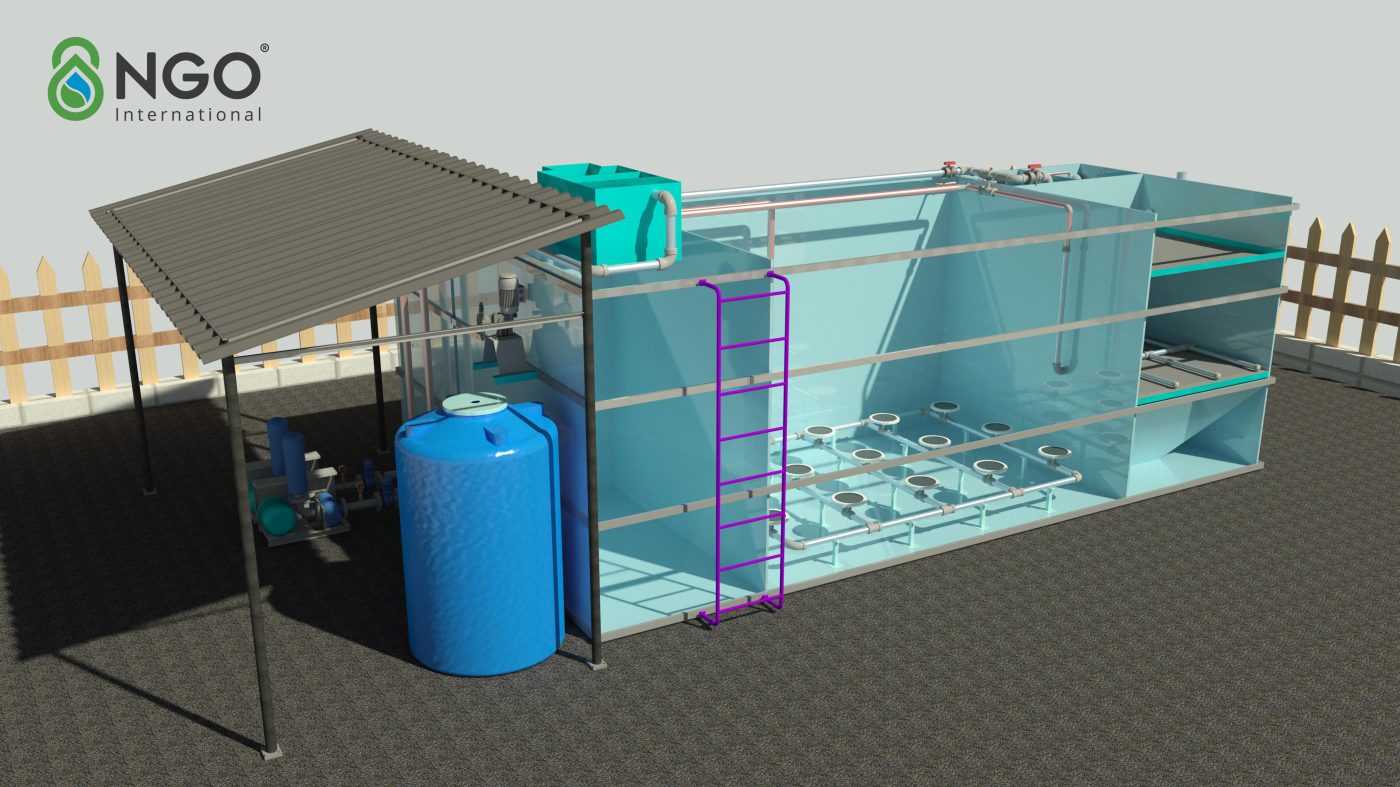
SmartB is the trade name of a domestic wastewater treatment solution researched and developed by NGO on the basis of moving or fixed biofilm layer technology. It overcomes the drawbacks of activated sludge or conventional MBBR technology, committing to stable treatment performance while keeping wastewater treatment costs low.
IV. 8 outstanding benefits of SmartB
Extremely low power consumption, under 0.2 kWh/m³ of wastewater, significantly reducing the monthly electricity bill.
The microbial (sludge) concentration in the treatment tank is exceptionally high (up to 8,000 mg/L), shrinking the system footprint to only half that of a conventional solution.
A unique technology that separates the biological environments creates ideal conditions for Nitrifier bacteria to grow, treating ammonium effectively even when the inlet concentration is > 60 mg/L.
All microorganisms attach firmly to the carrier material as a biofilm and are not washed out when the inlet flow or pollutant concentration changes suddenly.
No highly qualified staff are needed, and there is no need for complicated control of sludge flocculation. The system is designed to run almost automatically.
The sludge removal cycle extends beyond 6 months, reducing the burden of cost and procedures for handling hazardous sludge.
The smart design keeps the treatment tank volume always smaller than the total daily discharge capacity, optimising space.
The system can be built as a mobile module, easy to relocate, upgrade in capacity or transfer when necessary.

V. The Smart B treatment process
The process is designed to be streamlined yet deliver the highest treatment performance, in strict compliance with technical standards.
SmartB treatment process

Step 1: Pre-treatment
Raw wastewater passes through a bar screen and a grease trap to remove large debris and floating grease.
Step 2: Anoxic treatment
In the anoxic tank (DO < 0.3 mg/L), microorganisms carry out denitrification (NO₃⁻ removal) and also break down a considerable part of the COD and BOD.
Step 3: Aerobic treatment
In the aerobic tank (DO > 1.5 mg/L), nitrification proceeds vigorously, converting all ammonium (NH₄⁺) into nitrate (NO₃⁻). The remaining COD and BOD are also thoroughly treated.
Step 4: Polishing filtration & disinfection
After biological treatment, the water passes through a filter tank to remove any remaining total suspended solids (TSS) and ensure clear water. The water is then disinfected before being discharged to the receiving water body.
VI. Why is NGO a good choice for you?
- A supplier with a solid technology foundation, representing many major technology companies from around the world in Vietnam, with a well-structured development strategy;
- A solution proven in more than 100 projects;
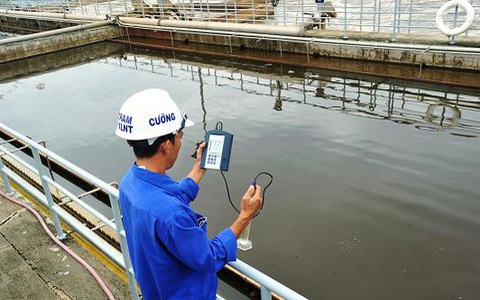
- With NGO, businesses are shown the tools to check water quality themselves, without depending on a third party, and can therefore verify the quality of the contractor and other parties involved;
- After-sales service is always ready when the business needs advice, support or troubleshooting, by phone, Zalo or direct meetings;
- Water quality is always stable, with no more worry about inspections by the authorities.
Case study 1: Project in Bac Giang

Case study 2: Project in Vinh Phuc

“Since working with NGO International and installing the SmartB system, we have been completely at ease. Operating costs have dropped noticeably, and we no longer worry whenever an inspection team visits. The treated water is clear and always meets the standard. It is truly a worthwhile investment.”
– Mr N.T.B, Head of Building Management Board –
Video: Domestic wastewater treatment plant
VII. Frequently asked questions
The initial investment cost of SmartB is competitive with other high-performance technologies such as MBR, but higher than cheap conventional systems. However, when the life-cycle cost is calculated (operating cost, maintenance, footprint), SmartB is the most economical solution in the long run.
Depending on capacity and complexity, the average time is 30-90 days. With the modular design, we can significantly shorten construction time on site.
This is exactly where SmartB® stands out. Thanks to the attached biofilm, the system has very high shock-load resistance and keeps treatment performance stable even when the characteristics of the incoming wastewater change.
We provide a comprehensive solution, not just equipment sales. The difference lies in a proven core technology, in-depth consultation, a written commitment to effluent quality, and lifetime after-sales service.
Very little. SmartB’s biofilm technology produces 50-70% less sludge than conventional activated sludge technology, saving you considerable sludge treatment costs.
See also:
https://shopngoenvironment.com/product/thiet-bi-mang-loc-e-mbr/
https://shopngoenvironment.com/product/mang-loc-mbr-x/
For detailed advice on domestic wastewater treatment solutions using SmartB technology, please contact us on +84 24 7300 0890 or email office@8ngo.com.

Talk to an NGO engineer
Free survey and consultation. Send us your wastewater type (industrial or domestic), flow rate (m³/day), influent analysis results if available and required effluent quality; an NGO engineer will propose a suitable technology and a realistic quotation.
Offices in Hanoi and Ho Chi Minh City · +84 24 7300 0890 · office@8ngo.com
This website is copyrighted by NGO International Co., Ltd (NGO International). Any use or reproduction of part or all of its content in any form is strictly prohibited without our express written permission.
See also: Industrial Wastewater Treatment — NGO Environment’s comprehensive solutions.