Tiếng Việt
 中文 (中国)

Service summary
| Service | Full environmental permit package: legal advice, dossier preparation, submission and follow-up, liaison with the licensing authority, permit adjustment |
|---|---|
| Who needs an environmental permit | From 18 May 2026: industrial wastewater to be treated from 100–150 m³/day (depending on the sector) or exhaust gas from 100,000 m³/hour; hazardous waste treatment facilities and scrap importers (Resolution 66.19/2026/NQ-CP) |
| Issuing authority | Chairman of the provincial People’s Committee in most cases; Ministry of Agriculture and Environment for inter-provincial hazardous waste treatment and scrap imports |
| Processing time | No more than 30 days (provincial People’s Committee) or 32 days (Ministry of Agriculture and Environment) from receipt of a valid dossier (Circular 09/2026/TT-BNNMT) |
| NGO’s strength | We prepare the dossier and also design and upgrade wastewater and exhaust gas treatment systems when they do not yet meet the technical regulations |
| Recognition | Top 100 Green and Sustainable Development Enterprises 2023 (view certificate) |
Free consultation. Talk to an NGO engineer via Zalo or hotline +84 969 867 924 – we respond right away.
An environmental permit (EP) is a legal document issued by a competent state authority to organisations and individuals engaged in production, business or service activities, allowing them to discharge waste into the environment, manage waste, or import scrap from abroad as production materials, together with the environmental protection requirements and conditions set by law.
1. Legal basis of the environmental permit
- Law on Environmental Protection 2020, as amended and supplemented by Law No. 146/2025/QH15 (effective from 1 January 2026);
- Decree 08/2022/ND-CP, as amended and supplemented by Decree 05/2025/ND-CP of 6 January 2025 and Decree 48/2026/ND-CP of 29 January 2026;
- Decree 131/2025/ND-CP on the delineation of authority of two-tier local government (effective from 1 July 2025);
- Government Resolution 66.19/2026/NQ-CP of 18 May 2026, applicable from 18 May 2026 to 28 February 2027 (news on the Government Portal, in Vietnamese);
- Circular 02/2022/TT-BTNMT, as amended and supplemented by Circular 07/2025/TT-BTNMT, Circular 07/2025/TT-BNNMT and Circular 09/2026/TT-BNNMT of 29 January 2026 (full text of Circular 09/2026 on the Government Portal, in Vietnamese).
2. Who needs an environmental permit (from 18 May 2026)
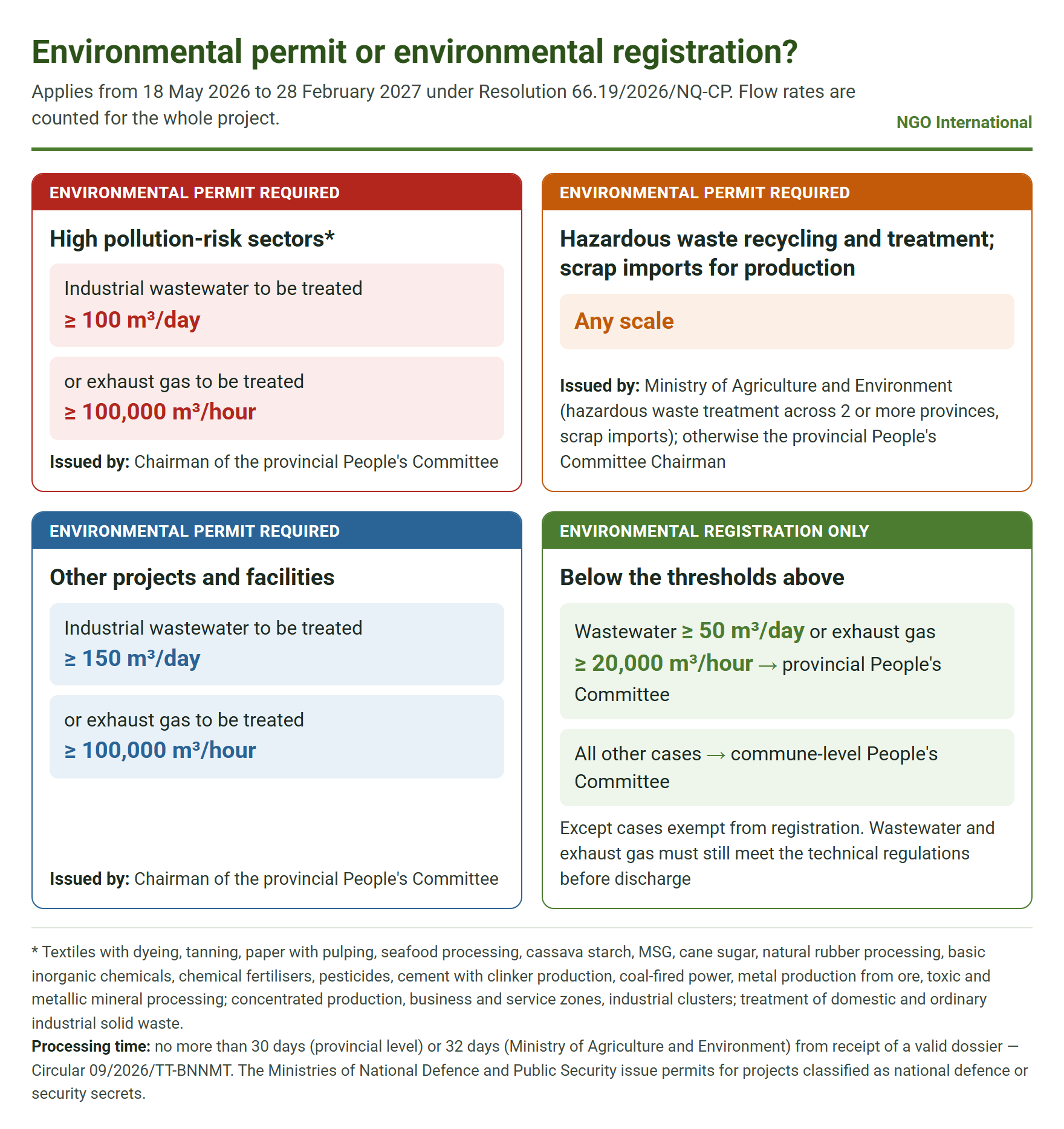
Under Resolution 66.19/2026/NQ-CP, investment projects and facilities that must obtain an environmental permit include:
- High pollution-risk sectors — textiles with dyeing, tanning, paper production with pulping, seafood processing, cassava starch, monosodium glutamate, cane sugar, natural rubber processing, basic inorganic chemicals, chemical fertilisers, pesticides, cement with clinker production, coal-fired power, metal production from ore, processing of toxic minerals and metallic minerals; concentrated production, business and service zones, industrial clusters; treatment of domestic solid waste and ordinary industrial solid waste — when the total industrial wastewater to be treated is 100 m³/day or more, or the exhaust gas to be treated is 100,000 m³/hour or more;
- Facilities providing hazardous waste recycling and treatment services; facilities importing scrap from abroad as production materials;
- Other projects and facilities when the total industrial wastewater to be treated is 150 m³/day or more, or the exhaust gas to be treated is 100,000 m³/hour or more.
Facilities below these thresholds carry out environmental registration: with the provincial People’s Committee if the wastewater to be treated is 50 m³/day or more, or the dust and exhaust gas is 20,000 m³/hour or more; with the commune-level People’s Committee in all other cases (except cases exempt from registration). Even without a permit, wastewater and exhaust gas must still meet the technical regulations before being discharged into the environment.
3. Permits integrated into the environmental permit
Under the Law on Environmental Protection 2020, the environmental permit has replaced and integrated 07 former environment-related permits and administrative procedures. These permits are no longer in force and have been merged into the environmental permit:
Certificate of completion of environmental protection works or waste treatment systems;Permit to discharge wastewater into water sources;Permit to discharge wastewater into irrigation works;Certificate of eligibility for environmental protection in importing scrap as production materials;Hazardous waste treatment permit;Hazardous waste source owner registration book;Industrial exhaust gas discharge permit.
Since 1 January 2022, when the Law on Environmental Protection 2020 took effect, all of the procedures above have been integrated into a single permit: the environmental permit.
4. Permit or environmental registration: which procedure applies
5. Dossier and submission timing
| Applicant | Dossier | When to submit |
|---|---|---|
| New investment projects with waste treatment works that require trial operation. |
| The environmental permit must be obtained before the trial operation of the waste treatment works (Article 42 of the Law on Environmental Protection). Projects subject to environmental impact assessment submit the dossier after completing the works that generate waste and the accompanying environmental protection works. Processing time from receipt of a complete and valid dossier: no more than 32 days for permits issued by the Ministry of Agriculture and Environment, and no more than 30 days for permits issued by the Chairman of the provincial People’s Committee (Article 18b of Circular 02/2022/TT-BTNMT, added by Circular 09/2026/TT-BNNMT). |
| Operating facilities that already hold component environmental permits. |
| The application must be submitted before the component environmental permit expires, at the latest 30 days (provincial People’s Committee) or 32 days (Ministry of Agriculture and Environment) before the date the environmental permit is required. The 1 January 2025 deadline for facilities operating before 1 January 2022 without component permits has passed: facilities that need an environmental permit but do not yet have one should prepare the dossier immediately to avoid penalties under Decree 45/2022/ND-CP. From 18 May 2026, facilities below the thresholds stated above only need environmental registration. |
6. Competent authorities issuing environmental permits (updated 10/2026)
From 1 July 2025, with the district level abolished, cases previously licensed by the district People’s Committee were transferred to the Chairman of the provincial People’s Committee (Decree 131/2025/ND-CP). From 18 May 2026 to 28 February 2027, under Resolution 66.19/2026/NQ-CP:
- Ministry of Agriculture and Environment: issues environmental permits to facilities providing hazardous waste recycling and treatment services operating in 02 or more provinces, and to facilities importing scrap from abroad as production materials.
- Ministry of National Defence and Ministry of Public Security: issue environmental permits to projects and facilities classified as state secrets in national defence and security.
- Chairman of the provincial People’s Committee: issues environmental permits to all other cases.
- Commune-level People’s Committee: does not issue environmental permits; receives environmental registrations from facilities with small wastewater and exhaust gas flows.
7. Term of the environmental permit
The term of an environmental permit is as follows:
- 07 years for Group I investment projects.
- 10 years for all other cases, namely Group II and Group III investment projects.
- The permit term may be shorter at the request of the project owner or facility.
The procedure for exchanging an environmental permit has been abolished (Law No. 146/2025/QH15, Decree 48/2026/ND-CP): a change of project or facility name or of owner only needs to be updated in the periodic environmental protection report. While Resolution 66.19/2026/NQ-CP applies (18 May 2026 – 28 February 2027), the re-issuance procedure is not carried out. Adding a plan to reuse, transfer or receive wastewater requires an adjustment of the permit; adjustments are processed within 15 days of receiving the request (Circular 09/2026/TT-BNNMT).
8. Trial operation of waste treatment works
Waste monitoring during trial operation follows Article 21 of Circular 02/2022/TT-BTNMT, as amended by Circular 07/2025/TT-BTNMT and Circular 09/2026/TT-BNNMT (updated 10/2026). Certain works are exempt from trial operation under Clause 1, Article 31 of Decree 08/2022/ND-CP (as amended by Decree 05/2025/ND-CP and Decree 48/2026/ND-CP).
a) Concentrated production, business and service zones, industrial clusters; large-capacity projects and facilities with a risk of environmental pollution (Column 3, Appendix II of Decree 08/2022/ND-CP):
| Item | Wastewater | Exhaust gas |
|---|---|---|
| Stage 1: Performance adjustment (at least 75 days) | ||
| Measurement and sampling frequency | At least once every 15 days | |
| Number of samples | 01 composite inlet sample and 01 composite outlet sample. | 01 composite inlet sample (if any) and 01 composite outlet sample. |
| Stage 2: Stable operation (at least 07 consecutive days) | ||
| Measurement and sampling frequency | At least once a day | |
| Number of samples | 01 grab inlet sample and at least 07 grab outlet samples over 07 consecutive days. | Grab samples or samples taken by continuous sampling equipment, before discharge into the environment. |
| Monitoring parameters | As specified in the issued environmental permit. | |
| Composite sample | 03 grab samples taken at 03 times of the day (morning, midday–afternoon, afternoon–evening) or at the start, middle and end of a production shift, mixed evenly. | Continuous sampling (isokinetic, isovelocity…), or the average of at least 03 measurements taken with rapid on-site measuring equipment at 03 times. |
Projects and facilities under Column 3 above only need to monitor at least 03 grab samples over 03 consecutive days of the stable operation stage (01 inlet wastewater sample and 03 outlet wastewater samples) for: domestic wastewater treatment systems (not combined with industrial wastewater treatment); wastewater and exhaust gas treatment systems with an additional stage added to improve treatment efficiency.
b) Other projects and facilities: the project owner decides on monitoring but must monitor at least 03 grab samples over 03 consecutive days of the stable operation stage (01 inlet wastewater sample and 03 outlet wastewater samples; 03 outlet dust and exhaust gas samples).
c) Wastewater treatment systems with a design capacity below 10 m³/day (counted separately for each system): monitor at least 01 grab sample of outlet wastewater.
9. A reliable, fast environmental permit service
Obtaining an environmental permit is a fairly complex and time-consuming procedure. To save time and obtain the permit smoothly, businesses and investors should work with a reputable company experienced in this service.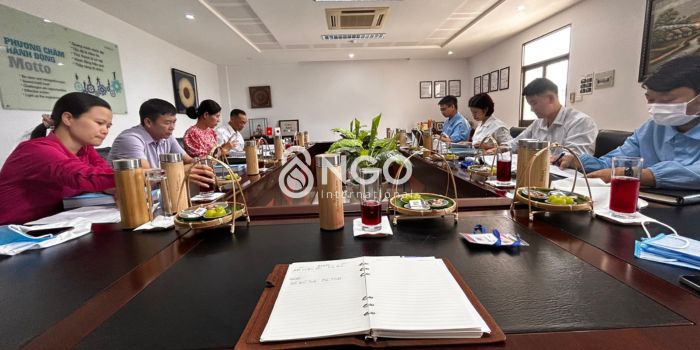 NGO International Co., Ltd specialises in preparing environmental permit dossiers. We understand the environmental field and have the experience and trust of partners we have worked with successfully. NGO’s environmental permit consulting service includes:
- Advice on legal issues related to obtaining an environmental permit;
- Advice and support in drafting the environmental permit dossier;
- Submitting the dossier on the client’s behalf, following up and updating the dossier status;
- Representing the client in working with the competent state authorities;
- Advice on other procedures such as permit adjustment and environmental registration.

10. Cost and process for obtaining an environmental permit with NGO
The cost of preparing an environmental permit dossier depends mainly on the type of production, scale, wastewater and exhaust gas flows, the number of treatment works and the current status of the facility’s environmental records. The information below helps NGO engineers identify the correct procedure (permit or environmental registration) and provide a realistic quotation.
Request a quotation and work with NGO
| Sector, capacity | Production sector, design and actual capacity |
|---|---|
| Wastewater, exhaust gas | Wastewater flow (m³/day), exhaust gas flow (m³/hour), discharge point |
| Existing records | EIA approval decision, component permits, environmental registration (if any) |
| Treatment works | Existing wastewater and exhaust gas treatment systems; latest monitoring results |
| Location | Province, industrial park or industrial cluster (if any) |
| Need | New permit or permit adjustment |
- Send your information
Send the information above via Zalo or hotline +84 969 867 924; an NGO engineer will respond right away.
- Initial consultation
We determine whether the facility needs a permit or environmental registration, the competent authority and when the permit is required; consultation is free.
- Site survey and sampling
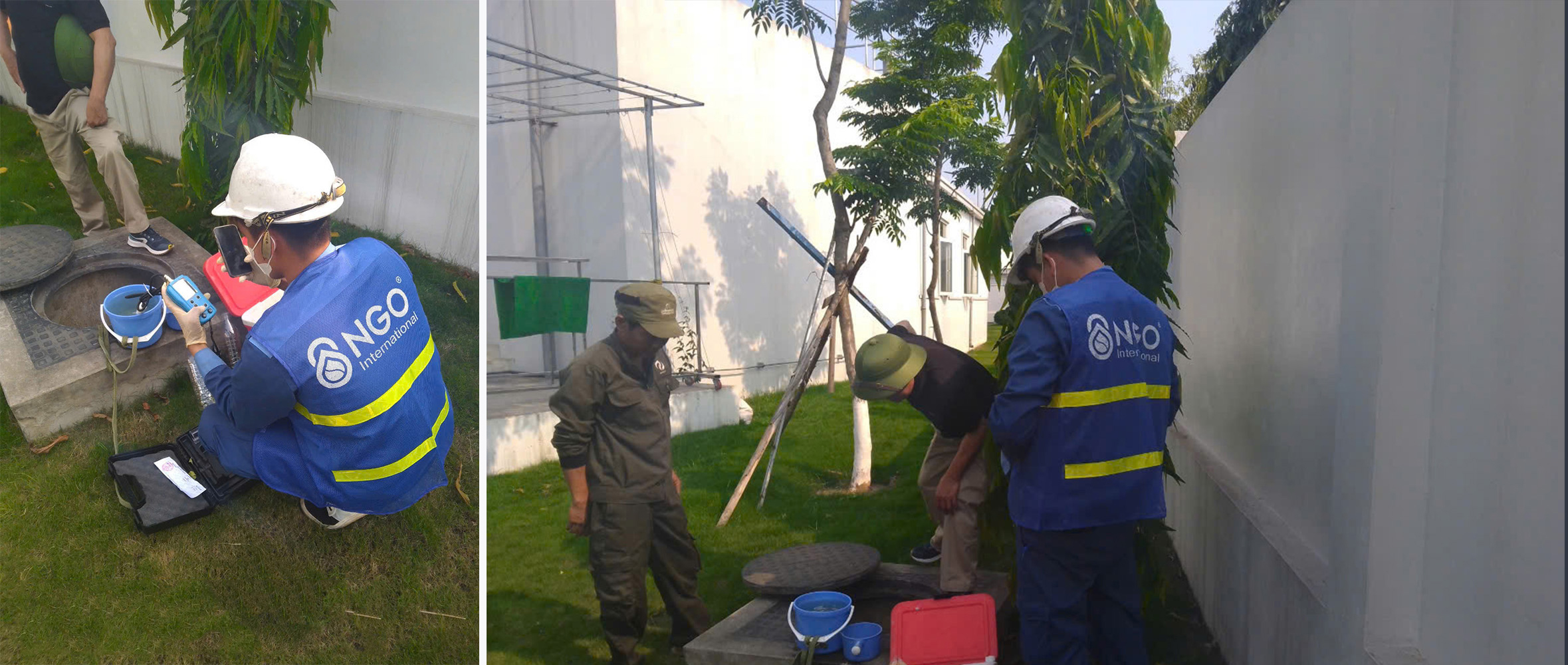
NGO engineers survey the current treatment works and take samples to assess compliance with the technical regulations before preparing the dossier; the survey is free.
- Proposal and quotation
Dossier plan, items to be upgraded if the treatment works do not yet comply, timeline and quotation.
- Implementation, construction and handover
We prepare and submit the dossier and work with the appraisal authority until the permit is issued; upgrade the treatment works when needed; hand over the permit and guide you on periodic environmental protection reporting.
Talk to an NGO engineer
Free consultation. Send us your sector, capacity and existing environmental records; an NGO engineer will respond right away and identify the correct procedure for your facility.
Offices in Hanoi and Ho Chi Minh City · +84 24 7300 0890 · office@8ngo.com
Please read the Terms of Use – Copyright carefully before copying or quoting any content or images from this website.
This website is copyrighted by NGO International Co., Ltd. Any use or reproduction of part or all of its content in any form is strictly prohibited without our express written permission.