Tiếng Việt
 中文 (中国)

An unstable supply water source full of hidden impurities is quietly eroding your production efficiency and raising your operating costs every day. White scale clogging the pipes, boilers needing constant maintenance, end products that fail to reach the required purity – are these the problems you are facing? Conventional treatment methods are reaching their limits and can no longer meet the increasingly strict requirements of modern production and environmental standards.
It is time for an in-depth, effective and reliable supply water treatment solution. NGO International brings ion exchange technology – the golden key that helps your business solve water quality challenges thoroughly and turn risk into a lasting competitive advantage.
1. Drawbacks of current supply water treatment technology
Water supply plants in Vietnam use a fairly simple treatment process, mainly conventional sedimentation and filtration (see https://ngoenvironment.com/en/tin-tuc-n5-process-of-water-supply-treatment-for-living-activities-at-water-plant-d227.html). This technology has the advantage of low investment cost and basically removes pollutants such as turbidity, organic matter at a low level (COD < 5 mg/L), and metals in the water such as Fe, Mn, Mg and Ca; however, the process also has many drawbacks:
- It uses chemicals such as lime water, PAC, polymer or potassium permanganate (KMnO4) to treat pollutants; if the chemicals are overdosed or dosed incorrectly, toxins are created in the water or the treatment efficiency is low.
- Water quality is managed through periodic (monthly, quarterly) testing by the authorities; many water plants have no automatic monitoring, which makes it hard to control water quality at all times, and water quality depends heavily on the operating skills and management capability of each investor. This is an illogical point in water quality management policy in Vietnam. Under the Law on Environmental Protection 2020 and Decree 08/2022/ND-CP, production facilities discharging from 500 m³/day to 1,000 m³/day must already install continuous automatic monitoring systems, whereas water supply plants with production capacities of up to hundreds of thousands of m³ of water/day have no similar management requirement.
- Conventional technology cannot treat complex pollutants in supply water when the source is polluted by non-compliant discharges from industrial and agricultural activities, or is affected by salinity, for example:
- High hardness (Ca²⁺, Mg²⁺): Causes scaling and blockage of pipes, cooling towers and boilers; reduces heat transfer efficiency and increases energy consumption.
- Heavy metals (arsenic, lead, chromium): Toxic, seriously harmful to health, and must be removed in accordance with QCVN 01-1:2024/BYT.
- Ammonium (NH₄⁺) and nitrate (NO₃⁻): Hinder disinfection, corrode pipes, and are strictly controlled parameters.
- Dissolved organic matter (refractory COD): Affects the colour and odour of the water and the quality of the end product.
2. Treatment solution using ion exchange (ion exchange resin) designed by NGO
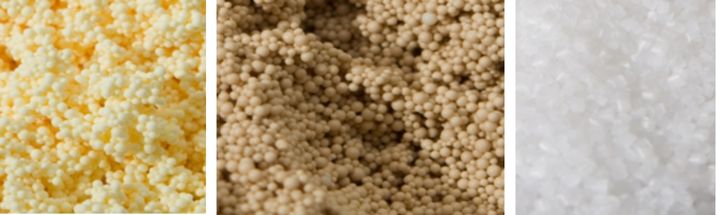
Treatment by ion exchange is highly efficient at removing ions from wastewater, including the cations that make water hard, soluble COD components and toxic metal pollutants in the water. Among advanced treatment methods, which include RO, electrolysis, electrodialysis and ion exchange, using ion exchange resin has the advantages of lower investment cost and simpler operation.
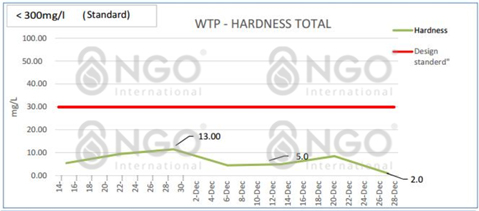
- WATER SOFTENING AND ITS EFFICIENCY
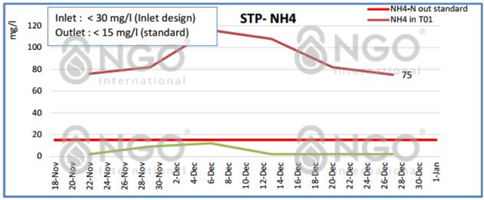
- AMMONIUM TREATMENT AND ITS EFFICIENCY

Ion exchange materials are also widely used in treating complex wastewater, mainly to remove heavy metals from the water
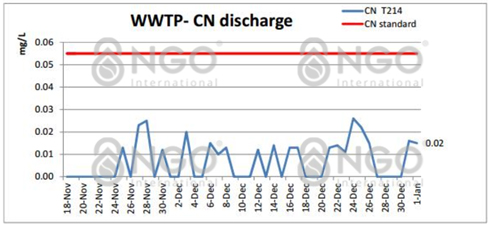
- CYANIDE TREATMENT AND ITS EFFICIENCY

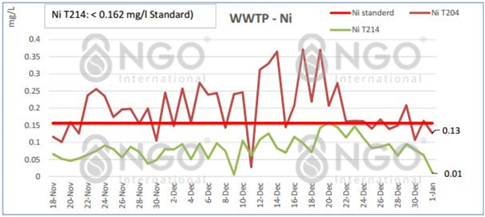
- NICKEL TREATMENT AND ITS EFFICIENCY

3. NGO supplies all ion exchange resin materials used for SUPPLY WATER, ULTRAPURE WATER and WASTEWATER
- Positive ion exchange resin – Cation Resin
- Negative ion exchange resin – Anion Resin
- Ion exchange resin with adsorption function – Macroporous adsorption Resin
- Water polishing resin – Mixed bed/ Polishing Resin
4. Why contact NGO when you need ion exchange materials or filtration systems?
- There are many trading companies on the market supplying ion exchange filter media, and there are thousands of different types of resin with different physicochemical properties; different water characteristics call for different materials, and above all the other components in the water that may hinder the material’s treatment process must be assessed. Therefore, you need a company with laboratory and design capability and a deep understanding of the materials, such as NGO, to avoid ineffective investment.
- NGO works directly with the scientists and the R & D department at one of the largest resin manufacturers in the world to select the right type of material for each problem a business faces in treating its supply water as well as the wastewater at its plant.
- NGO supplies materials to businesses directly from the manufacturer without any commercial intermediary; with NGO, the cost to the business is always optimised.
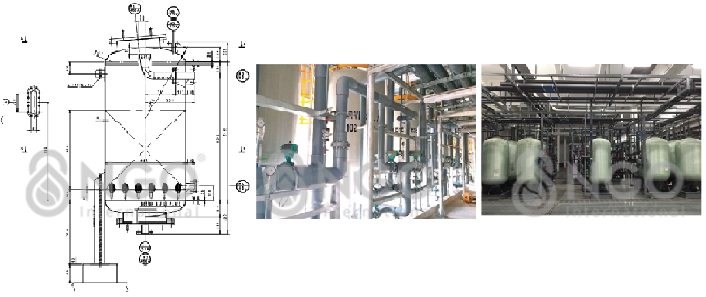
5. Ion exchange filter tanks and integrated water treatment systems
6. Featured project.
- Challenge: A large food processing plant in Dong Nai faced declining product quality because its supply water had high hardness (350 mg/L CaCO₃) and ammonium above the permitted limit. Boiler operating costs rose by 25% every year because of scale.
- NGO’s solution: After surveying and analysis, NGO International designed and installed a two-stage ion exchange system: a softening column using strong acid cation resin and a dedicated ammonium removal column.
- Results:
- Water hardness after treatment dropped to < 5 mg/L (a reduction of >98%).
- Ammonium content fell to a non-detectable level, meeting the standard for water used in food processing.
- Boiler and chemical operating costs fell by 20% in the first year alone.
- Stable product quality, highly rated by partners.
Testimonial:
“Since installing NGO International’s ion exchange system, we have been completely at ease about our water quality. Our equipment is protected and operating costs have dropped noticeably. NGO’s engineering team is very professional and has deep expertise.”
– Mr. T.T.D, Head of the Technical Department
7. Frequently asked questions.
The solution suits many industries such as food and beverage, pharmaceuticals, electronics, component manufacturing, industrial boilers, laboratories, and even high-end domestic use that needs soft water meeting the QCVN standards.
The resin can be regenerated for 200–300 cycles, depending on operating conditions and the quality of the input water. With a standard process, the average service life is 3–5 years before replacement is needed.
Ca²⁺, Mg²⁺, Fe³⁺ and Mn²⁺ ions, some heavy metals and total hardness.
No. Ion exchange systems have a compact column design that is easy to install in tight spaces, suits small and medium-sized plants as well, and can be expanded in modules if needed.
Yes. NGO provides independent system audits, performance analysis, technical assessment and proposals for operational improvements or suitable equipment upgrades, helping the system run more effectively and economically.
See also: https://shopngoenvironment.com/product/hat-nhua-trao-doi-ion/
Talk to an NGO engineer
Free survey and consultation. Send us your raw water source (with analysis results if available), capacity and the required treated-water quality; an NGO engineer will propose a suitable system and a realistic quotation.
Offices in Hanoi and Ho Chi Minh City · +84 24 7300 0890 · office@8ngo.com
Businesses interested in Supply water treatment solutions or in ion exchange materials are welcome to contact NGO by phone at +84 24 7300 0890 or by email at office@8ngo.com for direct consultation.  ***Please read the Terms of Use – Copyright carefully before copying or quoting any content or images from this website.
This website is copyrighted by NGO International Co., Ltd. Any use or reproduction of part or all of its content in any form is strictly prohibited without our express written permission.
See also: Industrial Supply Water Treatment — NGO Environment’s solution.