Tiếng Việt
 中文 (中国)

The centralised wastewater treatment plant of an industrial cluster usually has to be completed before most factories start operating, and then keep pace with wastewater volumes that grow with each round of investment attraction. NGO International Co., Ltd (NGO International), an industrial water and wastewater treatment company headquartered in Hanoi, has delivered the centralised plant for Yen Bang Industrial Cluster in Nam Dinh (now part of Ninh Binh province), with work starting in 2024. This article summarises NGO’s approach to industrial park and industrial cluster wastewater through projects in Nam Dinh and Thanh Hoa and a modular installation model.
Overview of wastewater treatment for industrial parks, industrial clusters and urban areas
Wastewater arriving at a centralised plant is a mix from many tenant companies, each of which has pre-treated it to the connection limits of the park or cluster. Its composition depends on the industries attracted: mechanical engineering and assembly clusters produce relatively stable wastewater, while clusters with textile dyeing, food processing or paper bring in higher COD, colour and pollutant loads that fluctuate from shift to shift. Urban wastewater is mainly domestic wastewater, more dilute, but its flow fluctuates sharply by the hour and in the rainy season.
The biggest difficulties usually arise during operation. While the occupancy rate is still low, the actual flow is only a small fraction of the design capacity and the biological system is hard to sustain. Once there are many tenants, a single non-compliant discharge is enough to shock-load the entire plant. Meanwhile, the land set aside for treatment infrastructure is often reduced to make room for leasable area.
Choosing technology for a centralised plant is therefore a matter of balancing many factors: capacity for each investment phase, the wastewater characteristics of the connected industries, discharge regulations (QCVN 40:2025/BTNMT for industrial wastewater), available area, automatic monitoring requirements and the potential for water reuse. Of these, the pace of occupancy is the hardest variable to predict, which is also why many plants are divided into units built in stages.
NGO International’s capabilities in industrial park and industrial cluster wastewater treatment
Founded in 2016, NGO International is headquartered in Hanoi with an office in Ho Chi Minh City. For centralised plants, the company takes on wastewater treatment work from survey, design, equipment supply, construction and commissioning through to handover with quality records. After handover, its operation consulting service trains staff, develops standard operating procedures and provides troubleshooting guidance; when the problem lies in the works themselves, the company upgrades the existing system in place. For infrastructure developers, NGO also handles EIA reports, environmental permit dossiers and operation management of the plant after handover.
Completed projects show two approaches commonly used for industrial clusters. Where land is still available, a compact block of treatment tanks is combined with biological ponds to reduce construction costs. Where land is limited or occupancy grows gradually, MBR membrane tanks housed in modules are added as wastewater volumes increase. For a 1,000 m³/day industrial cluster plant, NGO International revised the treatment model and reduced the construction footprint by more than 30%. Details of these options are on the industrial park and industrial cluster wastewater treatment page.
Featured projects by NGO International
The three projects below, together with the other videos on our featured projects page, represent three different approaches to centralised wastewater. The video at the top of this article records the Yen Bang Industrial Cluster plant from groundbreaking to completion, as well as the membrane installation at the 10,000 m³ plant. Some design parameters have been omitted to protect client confidentiality.
Centralised wastewater treatment plant, Yen Bang Industrial Cluster, Nam Dinh (now part of Ninh Binh)
| Location | Yen Bang Industrial Cluster, Nam Dinh (now part of Ninh Binh) |
|---|---|
| NGO’s scope | From groundbreaking, construction and installation to completion |
| Technology | Treatment tank block combined with aerated biological ponds |
| Year | Started in 2024 |
- The challenge
Yen Bang Industrial Cluster needed an entirely new centralised wastewater treatment plant, starting from the pile foundations, to receive wastewater from the companies in the cluster.
- NGO’s solution
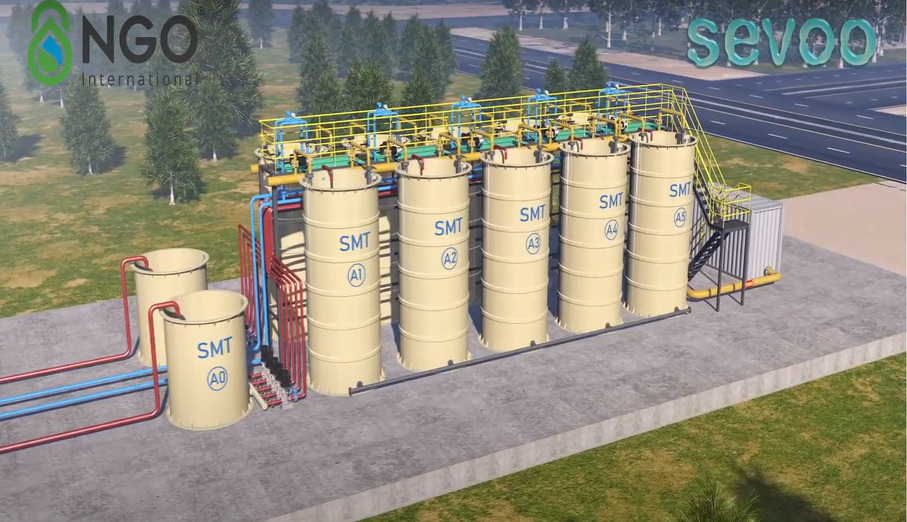
The site comprises a reinforced concrete treatment tank block with railings, an operations building and two lined biological ponds aerated by surface aerators. The function of each unit was calculated according to the cluster’s wastewater characteristics.
- NGO’s role
NGO International was on site from the groundbreaking ceremony in 2024, through construction and equipment installation, until the works were completed.
- Results / value delivered
The completed plant comprises the tank block, the operations building and two aerated biological ponds on the same site. Having one contractor follow the project from groundbreaking to completion helps the civil works and the equipment fit together from the start.
800 m³/day centralised wastewater treatment plant in Thanh Hoa
| Location | Thanh Hoa |
|---|---|
| Capacity | 800 m³/day |
| Model | Biological pond with pollutant treatment |
- The challenge
Keeping construction costs in line with an 800 m³/day scale without overloading the main treatment tanks.
- NGO’s solution
The biological pond was built into the treatment line as a pollutant treatment stage, not just a place to hold water.
- NGO’s role
Applying the biological pond with pollutant treatment model to the plant.
- Results / value delivered
The pond reduces the load on the downstream units, which allowed the plant to cut construction costs.
10,000 m³ wastewater treatment plant with modular MBR membranes
| Scale | 10,000 m³ |
|---|---|
| Technology | Flat-sheet MBR membranes housed in modules |
| Format | Modular installation, expanded in stages |
| Reuse | Treated water used for landscaping |
- The challenge
Wastewater volumes grow with occupancy, so investing in the full capacity at once can easily leave the plant running underloaded for years and tie up capital.
- NGO’s solution
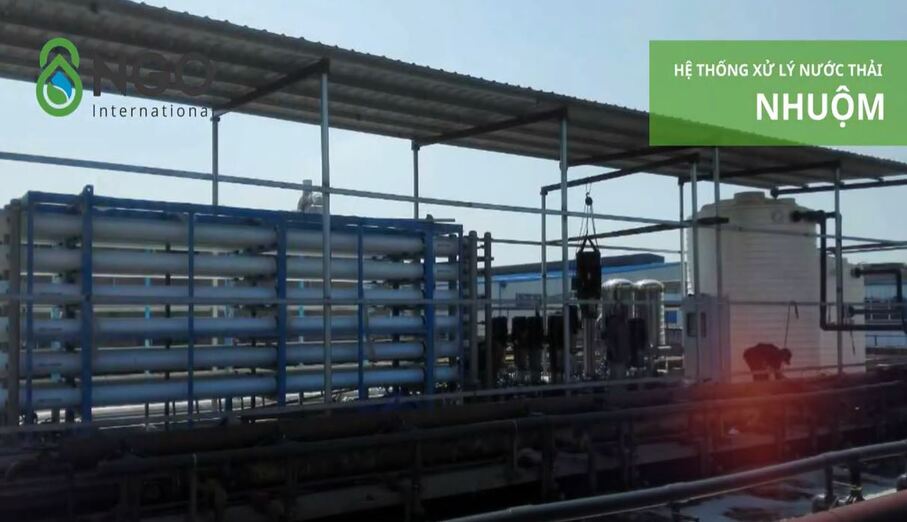
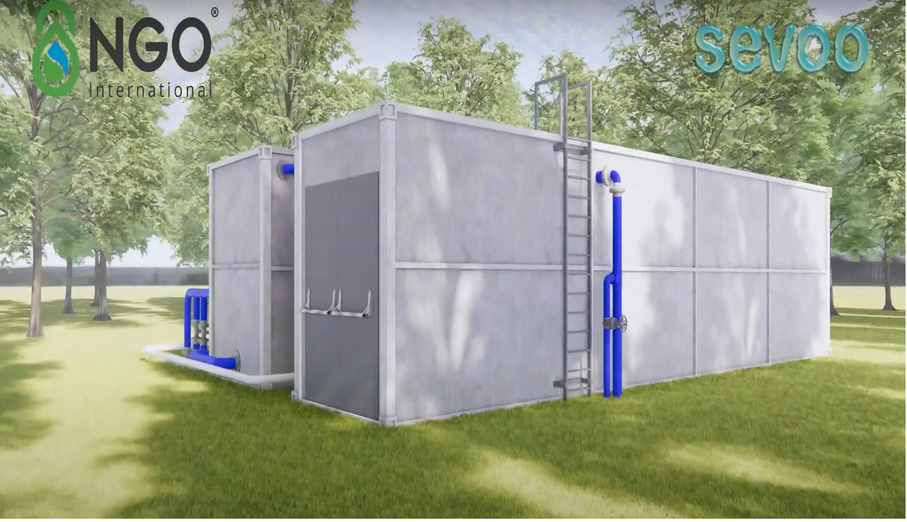
Modules containing flat-sheet MBR membranes are installed first for current demand and added gradually as wastewater volumes increase. The membranes replace the secondary clarifier, so the biological block has a very compact footprint.
- NGO’s role
NGO International installed the flat-sheet MBR membrane units in the modules; effluent parameters are monitored on a screen at the plant.
- Results / value delivered
The treated water is reused for landscaping. Investment costs follow actual demand instead of being concentrated in the initial phase.
Wastewater treatment technologies commonly used for industrial parks and industrial clusters
The part that gets little attention but determines the stability of the entire line is pre-treatment and equalisation: screens, grit removal and an equalisation tank large enough to smooth out flow and concentration over the day. Many centralised plants run unstably because the equalisation tank is too small, not because they lack technology.
When the cluster has industries that generate colour, metals or large amounts of suspended solids, a coagulation–flocculation or DAF flotation unit should be placed ahead of the biological stage to reduce the load and protect the biomass.
At the biological stage, activated sludge in AO, AAO or MBBR configurations has lower capital costs but needs settling tanks and a lot of space. MBR retains sludge with membrane filters, so the secondary clarifier can be eliminated and the effluent is clear and stable, making it suitable where land is limited or water reuse is needed; the trade-off is higher capital cost, energy use and membrane cleaning requirements. Biological ponds are an economical option where land is available, provided the retention time is carefully calculated and odour is controlled. A detailed comparison is available in the article on MBR membrane wastewater treatment technology.
The final stage includes disinfection, continuous automatic monitoring and sludge treatment. More and more investors are planning, right from the design stage, to reuse treated water for irrigation and road washing.
Industrial park and industrial cluster wastewater treatment in Nam Dinh (Ninh Binh)
Following the 2025 reorganisation of provincial-level administrative units, Nam Dinh, Ha Nam and the former Ninh Binh were merged into Ninh Binh province. Many planning documents, environmental permits and technical documents still use the old names, so both names should be cross-checked when preparing dossiers or looking for a contractor.
In the former Nam Dinh province, NGO International delivered the centralised wastewater treatment plant for Yen Bang Industrial Cluster (the project above). Also within present-day Ninh Binh province, the company took part in adjusting the operation of the wastewater treatment system of a textile dyeing industrial cluster: changing the operating procedures on the existing system to stabilise water quality and reduce the consumption of decolourising chemicals. Details are in the article on textile dyeing wastewater treatment.
Many industrial clusters in the former Nam Dinh province are linked to textiles and garments, mechanical engineering and craft villages. In clusters with textile dyeing, colour and COD are hard to treat by biological processes alone, so the scheme usually needs a physico-chemical or oxidation step, configured according to the sampling results for each waste stream. Infrastructure developers should settle four things early: the connection water quality limits for each company, the phased expansion plan, automatic monitoring requirements and the destination for waste sludge.
Besides Nam Dinh and Thanh Hoa, NGO International takes on the survey, design, construction and operation of centralised wastewater treatment plants for industrial parks and industrial clusters in the locations below, as well as the wastewater of individual connected industries such as textile dyeing, food and beverage, pharmaceuticals, or electroplating and electronic components. Bac Giang and Quang Ninh have many newly expanded industrial parks; Long An, Tay Ninh and Ba Ria – Vung Tau are major industrial areas around Ho Chi Minh City.
Where we work: industrial park and cluster wastewater
Northern Vietnam: Nam Dinh (now part of Ninh Binh), Bac Giang (now part of Bac Ninh), Quang Ninh
Central Vietnam: Thanh Hoa, Nghe An
Southern Vietnam: Long An (now part of Tay Ninh), Tay Ninh, Ba Ria – Vung Tau (now part of Ho Chi Minh City)
Why choose a contractor with hands-on experience?
A design error at a centralised plant does not stop at one company: it affects every connected tenant and the permit of the whole cluster. The questions worth asking a contractor are which centralised plants they have built, how many shifts of samples their design data came from, and how the scheme is phased so that the plant neither runs underloaded nor becomes overloaded.
Next come the ability to design and supply equipment as an integrated package, how well the technology suits the operating team that will take over, and how the contractor responds when an abnormal waste stream enters the plant. Most problems appear after handover, when the actual load deviates from the design data; experienced contractors usually monitor the initial operating period to make adjustments.
Frequently asked questions
NGO International delivered the centralised wastewater treatment plant for Yen Bang Industrial Cluster in Nam Dinh, now part of Ninh Binh province, from groundbreaking in 2024 through construction and installation to completion. The company has also adjusted the operation of the wastewater treatment system of a textile dyeing industrial cluster in the province.
Yes. Featured projects include the centralised plant for Yen Bang Industrial Cluster in Nam Dinh (Ninh Binh), an 800 m³/day plant in Thanh Hoa and a 10,000 m³ plant with modular MBR membranes. The scope can range from design and construction to operation consulting.
From the total registered discharge flow of the tenant companies, a safety factor and the pace of occupancy. Because flow increases gradually, capacity should be split into phases rather than built all at once.
Biological ponds suit sites where land is still available and construction costs need to be kept down. MBR suits sites where land is limited, stable effluent is needed for reuse, or modular expansion is desired; its electricity and membrane maintenance costs are higher.
From 1 September 2025, industrial wastewater discharged into a receiving water body is subject to QCVN 40:2025/BTNMT, under Column A, B or C depending on the receiving water body. Plants whose EIA was approved or whose environmental permit was issued before this date may continue to apply the old regulation until the end of 2031. Plants of concentrated production zones must also install automatic, continuous wastewater monitoring.
It depends on the technology and capacity. Biological ponds need the most land, and MBR is the most compact because it eliminates the secondary clarifier. For a 1,000 m³/day industrial cluster plant, NGO International’s revision of the treatment model reduced the construction footprint by more than 30%.
In Northern Vietnam: Nam Dinh (now part of Ninh Binh), Bac Giang (now part of Bac Ninh) and Quang Ninh; in Central Vietnam: Thanh Hoa and Nghe An; in Southern Vietnam: Tay Ninh (including the former Long An) and Ba Ria – Vung Tau (now part of Ho Chi Minh City). Two of the projects presented above are located in Nam Dinh and Thanh Hoa.
The former Nam Dinh province is now part of Ninh Binh province, together with Ha Nam and the former Ninh Binh, following the 2025 reorganisation of provincial-level administrative units.
Conclusion
Industrial park and industrial cluster wastewater changes over time: flow grows gradually, the connected industries change with each round of investment attraction, and available land keeps shrinking. A suitable solution must be compact, able to be built in phases and operate stably with the existing team.
From the centralised plant for Yen Bang Industrial Cluster in Nam Dinh (Ninh Binh) and the 800 m³/day plant in Thanh Hoa to the 10,000 m³ modular MBR plant, NGO International has worked with many different models for centralised wastewater. For infrastructure developers preparing to build a new plant or upgrade an existing one, the first step should be a site assessment with NGO’s technical team.
Contact NGO International