Tiếng Việt
 中文 (中国)

A pharmaceutical plant nearly had to recall an entire batch of medicine just because its water source did not meet the standard. This is not a rare situation – poor-quality pure water can contaminate products with bacteria, breach EU GMP/WHO standards and lead to serious losses. In the pharmaceutical industry, water is not only for drinking but also a raw material for making medicines, for cleaning equipment and for the cleanroom environment. If the water contains impurities or microorganisms above the limits, the quality of the medicine is directly affected.
Therefore, pharmaceutical companies have an urgent need for a compliant pure water treatment system to ensure safety, quality, stable operation and regulatory compliance.
1. Why supply water must be treated before use in pharmaceutical production.
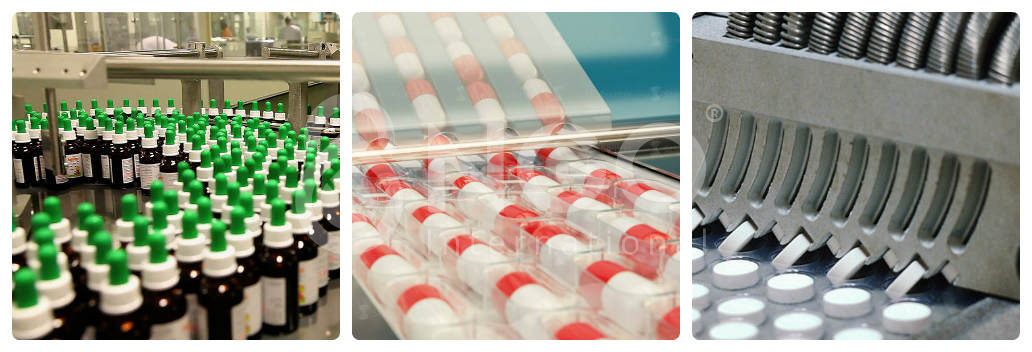
The water supplied to the pharmaceutical industry usually comes from the following sources:
- Groundwater
- Water from local clean water supply plants
Groundwater is typically characterised by many dissolved substances, mainly manganese, calcium and magnesium, while clean water from water supply plants is not of sufficient quality for production activities.
EU GMP and WHO standards set strict requirements for pharmaceutical water quality. Water used in making medicines must meet requirements for conductivity, microbial limits and endotoxins. For example, Purified Water (PW) under the Pharmacopoeia requires a conductivity of < 4.3 µS/cm (20°C) and microbes ≤ 100 CFU/mL, while Water for Injection (WFI) must be sterile with endotoxins < 0.25 EU/mL. If it fails, the company will breach GMP and risks having production suspended.
Using water that does not meet the standard can cause a production batch to be rejected if the test results of the water or the product fail the requirements. The cost of recalling defective products, destroying them and handling the incident is very large, not to mention lost revenue and brand image. Investing in an EU GMP-compliant water treatment system from the start is far cheaper than facing incidents and penalties for violations later.
Therefore, pharmaceutical companies must treat their incoming supply water to remove impurities or microorganisms that affect the quality of the medicines.
2. Pure water standards in the pharmaceutical industry.
Currently, Vietnam applies the GMP EU/WHO pure water standard to water used in pharmaceutical production. Specifically:
No. | PARAMETER | UNIT | CONCENTRATION BELOW LIMIT | ACCORDING TO GMP STANDARD |
01 | Odour – taste | 0 | Pharmacopoeia Vol. III – VN | |
02 | Calcium and magnesium | PPM | 0 | WHO |
03 | Colour | Pt – Co | 0 | Pharmacopoeia Vol. III – VN |
04 | Chloride | PPM | 0.5 | WHO |
05 | Sulphate | PPM | No colour change after 1 h | Determined per the Ph. Eur standard (Vol. II) |
06 | Oxidising substances | Concentration per BP standard | No colour change after 5 min | Ph.Eur |
07 | Ammonium | PPM | 0.2 | Ph.Eur |
08 | Nitrate | PPM | 0.2 | WHO |
09 | Aluminium | PPM | 0.01 | Ph.Eur |
10 | Heavy metals | PPM | 1 | Ph.Eur |
11 | Evaporation residue | % | 0.001 | Ph.Eur |
12 | Conductivity | µS/cm (25oC) | 1.3 (water used for preparing injections) | WHO |
3. Classification of water used in the pharmaceutical industry.
Water used in the pharmaceutical industry is normally divided into 04 types for different purposes:
- Domestic water is municipal tap water, used for canteens, toilets and watering plants outside the production area
- Demineralised water is water that has gone through water softening, with some other impurity ions and some microorganisms removed; it is mainly used for boiler water, autoclaves for injections and eye drops, and rinsing eye-drop bottles, syringes, machinery…
- Purified water is water used to prepare products that do not require sterility and must be free of pyrogens
- Distilled water
4. What factors should pharmaceutical manufacturers consider when investing in a supply water treatment system?
Currently, the technology process for treating supply water used in pharmaceutical production must ensure the following (03) factors:
- Water quality that meets the strict EU GMP standards
- A design that ensures stable, continuous 24/7 operation, with control and data storage systems that meet CFR 21 Part 11
- Clearly verified material standards and construction standards, ensuring a complete quality dossier (validation documents)
In addition, companies should also pay attention to some other factors:
- Requirements for machinery and equipment: technically sound, with a clear origin
- Analysing and surveying the incoming water source before treating it for production
- Analysing carefully the demand at each stage of pharmaceutical production, in order to design a reliable and efficient distribution system
- Considering long-term economic efficiency before investing, including operating, maintenance and servicing costs and labour
- Being able to provide after-sales technical support for technological equipment that needs periodic maintenance.
5. Pure water treatment solution for pharmaceutical companies provided by NGO.
Technological advantages:
- Concentrate from the filtration system can be reused, with no risk of oxidation of the RO filtration stage from oxidising gas
- Low electricity consumption in operation,
- Water quality meets GMP-WHO and EU GMP standards
6. NGO’s supply water treatment process to EU GMP standard.

To turn raw water (groundwater, tap water) into ultra-pure water that meets pharmacopoeia standards, NGO International applies a multi-stage technology process that is tightly controlled and automated. Each step is designed to solve a specific problem and to protect the steps that follow.
STAGE 1: PRETREATMENT – THE FOUNDATION THAT PROTECTS THE WHOLE SYSTEM
This is an important step that removes coarse impurities and chemicals in the source water, protecting the “heart” of the system, the RO membrane, from clogging and damage.
- Multi-media filtration: Removes suspended solids, sediment and turbidity.
- Activated carbon: Thoroughly adsorbs free chlorine – the oxidising agent that destroys the structure of RO membranes. It also removes colour, odour and organic compounds.
- Water softening: Removes calcium (Ca²⁺) and magnesium (Mg²⁺) ions – the main cause of scaling on the RO membrane surface – helping the system run stably and extending its service life.
STAGE 2: FINE TREATMENT – THE HEART OF THE SYSTEM
- Reverse osmosis (RO) system (1 or 2 passes): After pretreatment, the water is pumped at high pressure through ultra-fine RO membranes. This technology can remove up to 99.9% of dissolved ions, bacteria and viruses, producing highly pure water that meets most PW requirements. We prefer a 2-pass RO system (Double Pass) to keep the output water quality stable at the highest level.
STAGE 3: DEEP DEMINERALISATION – ACHIEVING ABSOLUTE PURITY
Although RO water is already very clean, a final deionisation step is needed to reach the extremely low conductivity required by EU GMP (< 1.3 µS/cm).
- EDI (Electrodeionization) technology: This is the most advanced and most preferred technology today. EDI uses electric current to continuously remove the remaining ions, giving the water very high purity.
Advantages: Automatic, continuous operation, extremely stable water quality, and no regeneration chemicals (acid/caustic) at all, which is safe for production and environmentally friendly.
- (Alternative) Ion exchange (Mixed-bed): A traditional technology that can still be used to optimise the initial investment cost, but it requires shutting the system down for chemical regeneration.
STAGE 4: ENSURING STERILITY AND DISTRIBUTION
- UV sterilisation: The treated water is irradiated by UV lamps to break down the DNA structure of any remaining microorganisms and prevent them from growing.
- Micro-filtration (0.2 µm): The final safety “checkpoint” before the storage tank, completely removing bacterial remains and the smallest particles.
- Storage and recirculating distribution: Pure water is stored in a 316L sanitary stainless steel tank and continuously circulates in a closed pipe loop to the points of use. This ensures consistent water quality at every point of use and prevents re-contamination.
ADVANCED STEP (Optional): DISTILLATION TO PRODUCE WATER FOR INJECTION (WFI)
- For production lines of injectable medicines and vaccines, purified water (PW) is passed through a multi-effect distillation system to remove bacterial endotoxins (pyrogens/endotoxins) completely, producing WFI that meets the highest pharmacopoeia standard.
Equipment for the system is designed, supplied, installed and periodically maintained by NGO:
- The RO filtration system consists of membranes and housings; we use a variety of RO equipment from different manufacturers to ensure effectiveness and investment cost suited to each company
- The Mixed-bed ion exchange system consists of filter tanks, solenoid valves and ion exchange material
- EDI equipment with its accompanying valves and pipework, originating from China or the EU
- Distillation equipment
- Sterilisation equipment
- Sensors for measuring and monitoring water quality at each treatment step
- Sanitary pipe system (Sanitary Pipes)
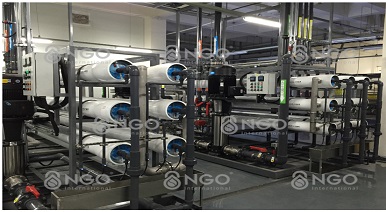
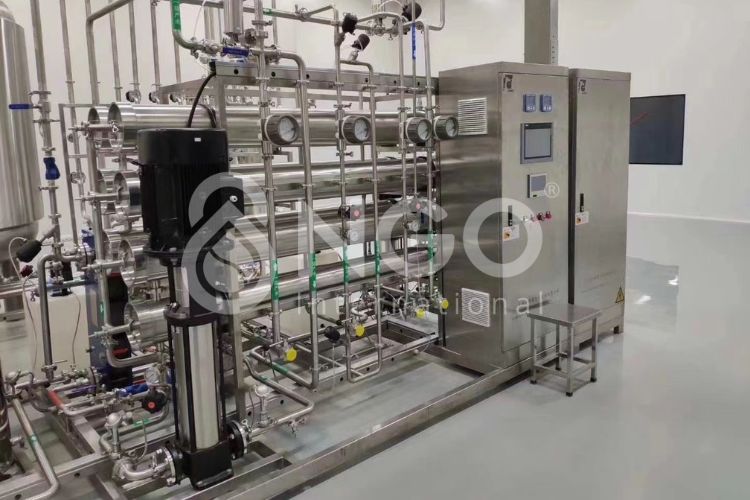
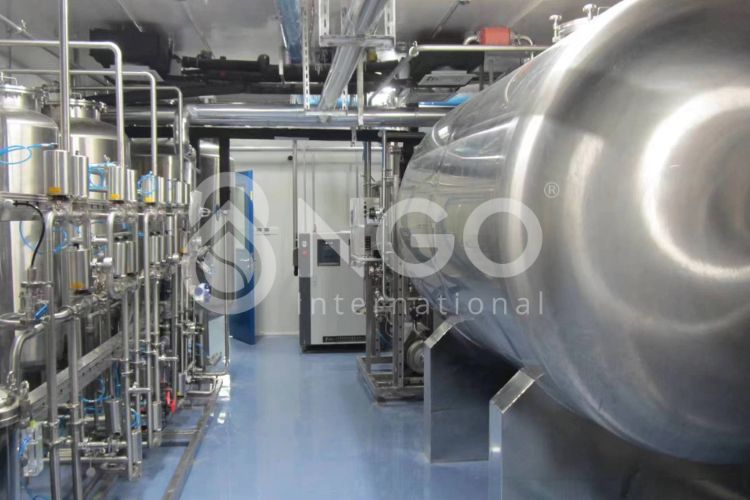
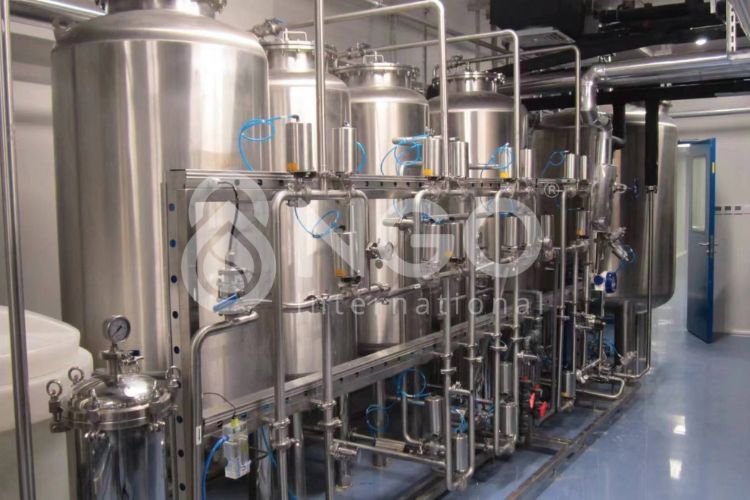
Some images of real projects:
7. Featured customer.
- Customer: A pharmaceutical company in Hung Yen that faced unstable output water: conductivity fluctuating between high and low, and occasional detection of bacteria above the limit, causing concern during GMP assessments. The cause was identified as the old system using resin ion exchange that had degraded
- Solution: NGO International advised on and installed an improved solution: replacing the old system with a modern two-pass RO + EDI + UV line
- Result: After implementation, the results were very impressive: the conductivity of the pure water dropped from 10 µS/cm to a stable 0.5 µS/cm, far below the GMP limit of 1.3 µS/cm. Total microorganisms in the water fell to below 1 CFU/100 mL (while the standard allows ≤ 100 CFU/mL), and endotoxins were not detected in 3 consecutive tests. Thanks to the high water quality, the company passed the EU GMP inspection without any non-conformity relating to water
“We have raised the quality of our production water thanks to the solution from NGO International. The new pure water system runs stably and helps our products consistently meet GMP standards. Since installation, the plant has not had a single water-related fault – this gives great peace of mind for every batch of medicine released.” – Mr V.H.T, Director of a pharmaceutical plant in H.Y
8. Frequently asked questions.
Because pure water that meets the standard is a mandatory GMP requirement for every medicine production process. Water that does not meet the standard can contaminate products, breach regulations and endanger users. Using GMP-standard pure water helps ensure medicines are safe and effective and lets the company avoid legal risks.
Purified Water (PW) is water from which most ionic, organic and microbial impurities have been removed, used to make oral and topical medicines and to wash equipment. Distilled water (Water for Injection – WFI) is a higher grade of purified water, sterilised and free of endotoxins, used specifically to prepare injectable medicines or eye drops. Put simply, WFI is absolutely pure water, with stricter requirements than PW for microorganisms and endotoxins.
NGO International applies modern technology to produce ultra-pure water that meets demanding standards. The system is automatically controlled, uses no regeneration chemicals, saves energy and is environmentally friendly. The flexible design suits medium and large companies. Professional after-sales service helps the system run stably in the long term.
The system needs periodic maintenance to run efficiently: replacing coarse filter cartridges, cleaning the RO membranes, calibrating measuring sensors, checking the UV lamps and cleaning the storage tank/pipework. Equally important, initial validation (IQ/OQ/PQ) must be carried out when the system is installed. Re-qualification is then carried out annually or when there is a major change, to make sure the system always meets the design standard and the output water quality. Water samples are also sent for periodic testing (weekly/monthly) to make sure the parameters always stay within GMP limits.
The initial investment cost of a pharmaceutical pure water system can be significant, depending on scale and technology. In the long run, however, it is an efficient, cost-saving investment. A compliant system avoids losses from spoiled product batches and penalties for GMP violations. At the same time, modern technology reduces operating costs (low consumption of chemicals and labour), giving a fast payback.
Pure water and pure steam treatment system at PHARMED & HEALTHCARE VIETNAM 2023:
Pharmaceutical manufacturers interested in an incoming supply water treatment solution, please contact NGO on +84 24 7300 0890 or by email at office@8ngo.com for direct consultation.
See more at:
https://shopngoenvironment.com/product/mang-ro-cho-cn-thuc-pham-do-uong-duoc-pham/
https://shopngoenvironment.com/product/thiet-bi-lam-mem-nuoc/

Talk to an NGO engineer
Free survey and consultation. Send us your raw water source (with analysis results if available), capacity and the required treated-water quality; an NGO engineer will propose a suitable system and a realistic quotation.
Offices in Hanoi and Ho Chi Minh City · +84 24 7300 0890 · office@8ngo.com
This website is copyrighted by NGO International Co., Ltd. Any use or reproduction of part or all of its content in any form is strictly prohibited without our express written permission.
See also: Industrial Supply Water Treatment — NGO Environment solutions.
See also: GMP-Standard Pharmaceutical Supply Water Treatment — NGO Environment solutions.