Tiếng Việt
 中文 (中国)

In recent years, the beverage industry in Vietnam has contributed > 10% of national GDP and has kept up an impressive growth rate. The average annual growth rate of this segment over 2023-2028 is expected to reach 6.28%
Rising consumer demand for beverages also drives the growth of the supply chain for aluminum packaging (aluminum cans), especially as aluminum cans have an advantage in reuse over other packaging types as businesses work towards green packaging
1. Aluminum can production process
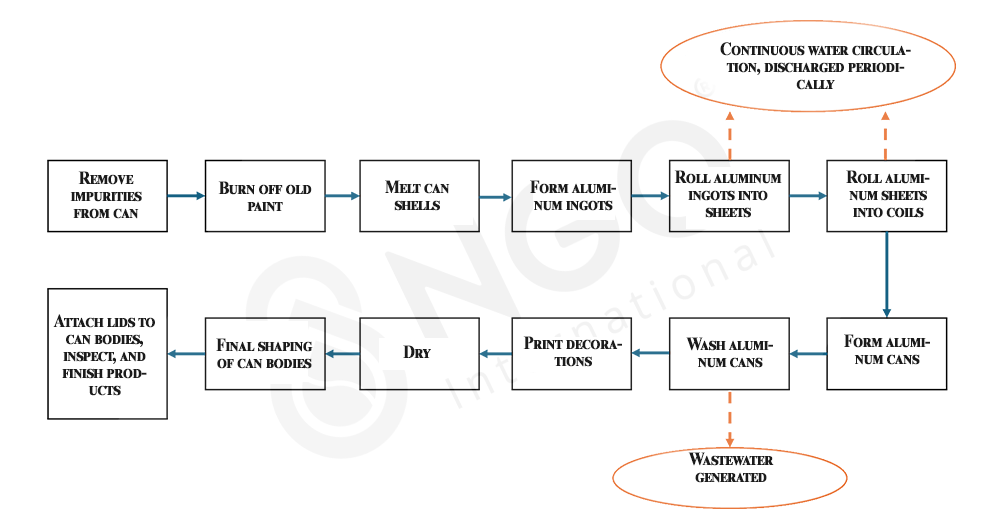
2. Challenges and difficulties in treating aluminum can production wastewater
a. Typical wastewater characteristics
The composition and properties of aluminum production wastewater are mainly heavy metals, mineral oil and grease, and organic compounds.
– Contains heavy metals such as aluminum, chromium, nickel and cadmium, which can appear in wastewater from plating, anodising and surface protective coating of aluminum cans…
– High COD and BOD: because of organic compounds in paints, printing inks and surface treatment chemicals, aluminum can production wastewater can have high chemical oxygen demand (COD) and biochemical oxygen demand (BOD)
– High suspended solids (TSS): suspended solids are common in the wastewater because of aluminum dust, aluminum shavings and other impurities left over from cutting, stamping and machining
| Parameter | Unit | Concentration range | Source |
|---|---|---|---|
| Heavy metals | |||
| Aluminum (Al³⁺) | mg/l | 150 – 300 | Cleaning, anodising, protective plating |
| Chromium (Cr⁶⁺, Cr³⁺) | mg/l | 0.1 – 5 | Anodising, corrosion protection |
| Nickel (Ni²⁺) | mg/l | 0.1 – 3 | Protective plating, aluminum alloys |
| Zinc (Zn²⁺) | mg/l | 0.2 – 10 | Paint coating, corrosion protection |
| pH | – | 3 – 12 | Acid or alkaline cleaning |
| Solids | |||
| Total suspended solids (TSS) | mg/l | 200 – 500 | Sludge, metal residue |
| Organics and oil & grease | |||
| Chemical oxygen demand (COD) | mg/l | 200 – 1000 | Cleaning chemicals, oil emulsions |
| Mineral oil and grease | mg/l | 10 – 400 | Lubricating oil, surface protectants |
| Other compounds | |||
| Ammonium (NH₄⁺-N) | mg/l | 5 – 50 | Additive chemicals |
| Sulfate (SO₄²⁻) | mg/l | 200 – 2000 | Use of sulfuric acid in anodising |
📌 Note: The concentration table is for reference only; actual concentrations may vary depending on the production technology and the pollution control measures at each plant.
3. Aluminum can wastewater treatment solution provided by NGO International
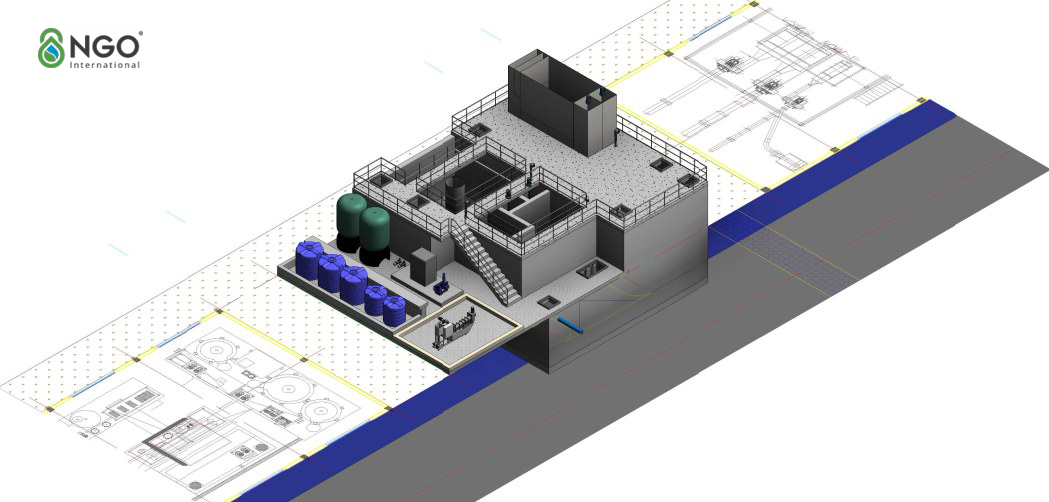

Small treatment volume & footprint
We separate the streams and thoroughly pre-treat the specific, highly polluted sources to reduce the pollution load of the whole plant, which reduces the reaction volume of the tanks and the construction volume.

Optimised investment cost
With a good understanding of the properties and pollutants in the wastewater, NGO can optimise the design with 100% of the equipment made in Vietnam to optimise the investment cost.

Wastewater reuse & recirculation
Instead of wasting a valuable resource, treated wastewater can be reused in production, moving towards a zero-discharge plant model
Today, treated wastewater usually meets QCVN 40:2025/BTNMT (in Vietnamese) and is discharged into the environment. However, as the environment receives growing attention and clean water becomes ever scarcer, treating wastewater only to meet discharge standards is no longer the most economical and effective solution in modern industry. In the trend towards sustainable development in particular, wastewater reuse is becoming a strategic direction.
4. Featured project
- Customer: A large-scale aluminum can plant in an industrial park in Southern Vietnam.
- Challenge: The old system was overloaded, operating costs were high, and the treated water quality was unstable and often exceeded the QCVN 40 limits. Management wanted a sustainable solution that moves towards water reuse.
- NGO International’s solution: We surveyed, designed and built a new treatment system using high-efficiency coagulation – flocculation technology combined with UF and RO membrane filtration.
- Results:
- 98% of the heavy metal and COD load removed.
- Treated water consistently meets QCVN 40:2025/BTNMT, Column A.
- 60% of the wastewater is reused for can washing and the cooling tower system.
- Operating costs (chemicals, electricity) reduced by 35% compared with the old system.
“Since working with NGO International, we no longer have to worry about environmental issues. The new system runs stably at a reasonable cost, and above all, reusing the wastewater has saved us a considerable amount of money. It is truly a worthwhile investment.”
– Mr. V.H.T, Plant Director
5. Frequently asked questions
The cost depends on many factors: the wastewater flow (m³/day), the inlet pollutant concentration, and the required effluent quality (discharge only or reuse). NGO International will survey the site and provide the most optimal quotation for each specific case.
We prioritise highly automated solutions that minimise human intervention. NGO International will train your team and transfer the technology thoroughly until they can operate the system proficiently.
Usually 3-6 months, depending on the scale and complexity of the project, including the design, construction and trial operation stages.
Water that has passed through the advanced treatment system (UF and RO membrane filtration) can be reused for purposes such as the initial can-washing stage, cleaning workshop floors, watering plants, and make-up water for cooling towers.
Our system includes sludge handling equipment (a filter press) to reduce the sludge volume to a minimum. The pressed sludge is collected and handled by licensed units in accordance with the law.
Businesses interested in an aluminum can production wastewater treatment solution are welcome to contact NGO on +84 24 7300 0890 or by email at office@8ngo.com for direct consultation.
See more at:
https://shopngoenvironment.com/product-category/san-pham-cong-nghiep/thiet-bi-tuyen-noi/

Talk to an NGO engineer
Free survey and consultation. Send us your wastewater type (industrial or domestic), flow rate (m³/day), influent analysis results if available and required effluent quality; an NGO engineer will propose a suitable technology and a realistic quotation.
Offices in Hanoi and Ho Chi Minh City · +84 24 7300 0890 · office@8ngo.com
***Please read the Terms of Use – Copyright carefully before copying or quoting any content or images from this website.
This website is copyrighted by NGO International Co., Ltd. Any use or reproduction of part or all of its content in any form is strictly prohibited without our express written permission.