Tiếng Việt
 中文 (中国)

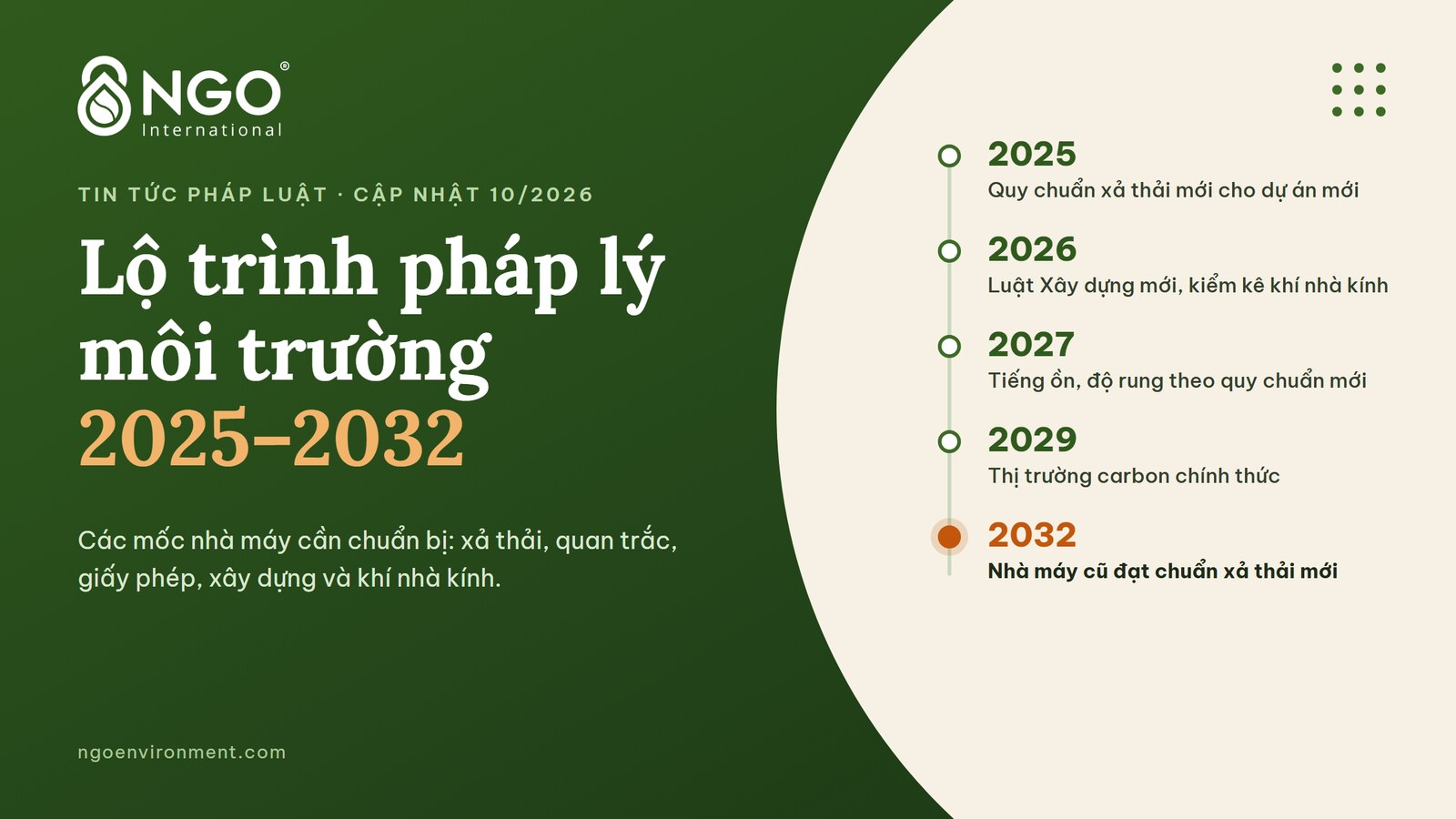
The period 2025–2032 brings major changes to environmental law: most national technical regulations (QCVN) on discharge have been reissued, the new Law on Construction is in force, and the monitoring thresholds and permitting procedures have been adjusted. For an operating plant, the new discharge standards become mandatory mainly from 1 January 2032, but several obligations already apply or are about to fall due: wastewater fees, greenhouse gas inventories, packaging recycling responsibility, and noise and vibration from 1 January 2027. Every investment decision from now on should take these milestones into account, so that you do not have to invest twice.
This article sets out the milestones that directly affect factories, farms, and industrial parks and clusters, updated to October 2026, together with what to do at each milestone.
Summary in one minute
Operating plants must meet QCVN 26:2025 and QCVN 27:2025.
Industrial wastewater (QCVN 40:2025), domestic wastewater (QCVN 14:2025), livestock wastewater (QCVN 62:2025); emissions to air (QCVN 19:2024, which provinces may require earlier).
Projects of up to VND 40 billion need only an economic and technical report; there is no separate permit exemption for works inside industrial parks.
Mandatory for industrial parks and clusters from 500 m³/day; for plants from 500 or 1,000 m³/day depending on the type of operation.
Paper, textile dyeing, steel, plating, cement, food and beverage, electronics and other sectors must apply them to at least one process stage.
2,441 facilities must carry out inventories; emission reduction reports every year from 2027; the carbon market formally operates from 2029.
Read by sector
| Sector | Sections to read |
|---|---|
| Food, beverage, seafood, starch | 2, 3, 4, 7, 9 |
| Textile dyeing, paper, leather tanning | 2, 4, 7, 9 |
| Steel, cement, chemicals, fertiliser | 2, 4, 5, 8, 9 |
| Plating, electronic components, electrical equipment | 2, 4, 5, 7, 9 |
| Pharmaceuticals, cosmetics, packaged goods | 2, 4, 7, 9 |
| Livestock, slaughterhouses | 3, 7, 9 |
| Industrial parks and clusters | 2, 5, 7 |
| Water treatment plants, water supply projects | 5, 6 |
If you only have 5 minutes: read section 1 to see the whole timeline, then section 10 to check your own plant.
1. The full roadmap, 2025–2033
| Milestone | Details |
|---|---|
| 1 July 2025 | QCVN 19:2024 (emissions to air) takes effect, applying to new and expanded projects |
| 1 September 2025 | QCVN 40:2025 (industrial wastewater), 14:2025 (domestic) and 62:2025 (livestock) take effect for new projects |
| 14 November 2025 | QCVN 26:2025 (noise) and 27:2025 (vibration) take effect for new projects |
| 1 January 2026 | Environmental protection fee on wastewater under Decree 346/2025, paid quarterly; the EU Carbon Border Adjustment Mechanism (CBAM) enters its definitive period; ban on producing and importing hard-to-degrade plastic bags smaller than 50×50 cm and thinner than 50 µm (except for export goods and bags used to package goods being sold) |
| 29 January 2026 | Decree 48/2026: new automatic wastewater monitoring thresholds; some industrial clusters are not required to build a centralised treatment plant (see section 7) |
| 9 February 2026 | QCVN 07:2025 (hazardous waste thresholds, including sludge from water treatment) and QCVN 30:2025 (waste incinerators) take effect |
| 18 May 2026 | Resolution 66.19/2026 raises the threshold for requiring an environmental permit and delegates authority to the provinces (until the end of 28 February 2027) |
| 25 May 2026 | Decree 110/2026 on the recycling responsibility of producers and importers (EPR) |
| 1 July 2026 | Law on Construction 135/2025 and Decree 217/2026 take effect |
| 25 September 2026 | List of 2,441 facilities required to carry out greenhouse gas inventories (Decision 42/2026) |
| Now: October 2026 | |
| 1 January 2027 | Operating plants must meet QCVN 26:2025 and 27:2025 |
| 15 January each year | Report on environmental protection work for the previous year (industrial parks and clusters: 20 January) |
| 28 February 2027 | End of the period of application of Resolution 66.19/2026 (or earlier if a replacement document is issued) |
| 31 March 2027 | Facility-level greenhouse gas emission reduction report, first time and then every year; next greenhouse gas inventory period (expected, see section 8) |
| 1 April · 20 April 2027 | Registration or declaration of recycling responsibility; payment of the contribution (every year) |
| 2029 | Domestic carbon market formally operates; mandatory recycling rates increase for the first time |
| 1 January 2030 | Deadline for applying best available techniques (BAT), to be completed before this date: Level I investment projects |
| 31 December 2030 | After this date, production and import of single-use plastic products stop (with exceptions) |
| 1 January 2031 | BAT, to be completed before this date: operating Level I facilities; Level II projects |
| 1 January 2032 | Operating plants and farms must meet QCVN 40:2025, 14:2025, 62:2025 and 19:2024 from this date; BAT, to be completed before this date: Level II facilities, Level III projects |
| 1 January 2033 | BAT, to be completed before this date: operating Level III facilities |
The BAT milestones are deadlines of the form “before this date”. Provincial People’s Committees may issue a roadmap for applying QCVN 19:2024 earlier than 2032.
2. Industrial wastewater: QCVN 40:2025
Circular 06/2025/TT-BTNMT, signed on 28 February 2025, effective from 1 September 2025. Dedicated article: QCVN 40:2025 industrial wastewater.
What this regulation replaces
QCVN 40:2025/BTNMT replaces QCVN 40:2011/BTNMT and merges the previous sector-specific regulations into one common regulation. Plants in the sectors below no longer have a regulation of their own:
- Seafood processing (QCVN 11-MT:2015), paper and pulp (QCVN 12-MT:2015), textile dyeing (QCVN 13-MT:2015), steel production (QCVN 52:2017);
- Natural rubber primary processing (QCVN 01-MT:2015), fuel alcohol production (QCVN 60-MT:2015), cassava starch processing (QCVN 63:2017);
- Medical wastewater (QCVN 28:2010), solid waste landfills (QCVN 25:2009), petrol depots and filling stations (QCVN 29:2010).
It does not apply to livestock wastewater, domestic wastewater, urban and concentrated residential area wastewater, or water extracted from offshore oil and gas facilities (see section 3).
Application timeline
| Subject | Application of QCVN 40:2025 |
|---|---|
| New investment projects, and projects that expand scale or increase capacity | From 1 September 2025, applied immediately when the environmental dossier is submitted. |
| Operating facilities; projects whose environmental impact assessment (EIA) report was approved, or whose full dossier was submitted, before 1 September 2025 | May continue to apply the old regulation until the end of 31 December 2031; must meet QCVN 40:2025 from 1 January 2032. Early application is encouraged. |
Three important technical changes
- Three receiving water body levels: Column A, B, C (replacing the two columns A and B). Column A: discharge to a water body used for domestic water supply, or managed under level A of QCVN 08:2023/BTNMT, or as set by the provincial People’s Committee; Column B: a water body managed for improving water environment quality, or as set by the provincial People’s Committee; Column C: all other cases. Where no zoning has been made, Column B applies.
- Limits depend on discharge flow rate F: split into two groups, F ≤ 2,000 m³/day and F > 2,000 m³/day; the larger the plant’s discharge, the stricter the limits. The new regulation no longer uses the Kq and Kf multiplication factors of QCVN 40:2011.
- TOC may be measured instead of COD, with its own limit values for TOC.
Main limits under QCVN 40:2025 (mg/L)
Discharge flow rate F ≤ 2,000 m³/day
| Parameter | Column A | Column B | Column C |
|---|---|---|---|
| BOD₅ | 40 | 60 | 80 |
| COD | 65 | 90 | 130 |
| TOC (instead of COD) | 35 | 50 | 75 |
| TSS | 40 | 80 | 120 |
Discharge flow rate F > 2,000 m³/day
| Parameter | Column A | Column B | Column C |
|---|---|---|---|
| BOD₅ | 30 | 50 | 60 |
| COD | 60 | 70 | 90 |
| TOC (instead of COD) | 25 | 40 | 50 |
| TSS | 30 | 60 | 80 |
Excerpt from Table 1, QCVN 40:2025/BTNMT. For other parameters (pH, total N, total P, ammonium, metals, coliform, etc.) see Table 2 of the regulation.
Comparison with the old standard: not every parameter is stricter
Column B, unit mg/L; F is the discharge flow rate (m³/day); the old standard is the C value of QCVN 40:2011.
| Parameter | Old standard | New, F ≤ 2,000 | New, F > 2,000 |
|---|---|---|---|
| COD | 150 | 90 (stricter) | 70 (stricter) |
| TSS | 100 | 80 (stricter) | 60 (stricter) |
| BOD₅ | 50 | 60 (more lenient) | 50 (unchanged) |
Under QCVN 40:2011, a plant’s actual limit is the C value multiplied by the receiving water body factor Kq (0.6–1.3) and the flow rate factor Kf (0.9–1.2). So the actual degree of tightening differs between plants and must be calculated case by case. COD is usually the parameter that decides which treatment stage has to be added.
Worked example
A food plant discharges 800 m³/day into a river with a flow below 50 m³/s, with Column B applying. Under QCVN 40:2011, the COD limit is 150 × 0.9 (Kq) × 1.0 (Kf) = 135 mg/L. Under QCVN 40:2025 it is 90 mg/L, about one third stricter. The effluent COD is currently stable at about 120 mg/L: it meets the old standard, but from 1 January 2032 it will not. If in 2028 the plant renovates and replaces equipment in the treatment plant (without increasing scale or capacity) to the old design, the items just completed may have to be renovated again before 2032. If it is designed to QCVN 40:2025 from the very first renovation, only one investment is needed. Note: if the plant expands scale or increases capacity, the environmental dossier of the expansion project submitted after 1 September 2025 must apply QCVN 40:2025 immediately, without waiting until 2032.
Plants inside industrial parks and clusters
A plant connected to a centralised treatment system must meet the connection requirements of the infrastructure investor, not QCVN 40:2025 directly. However, the centralised treatment plant of the industrial park or cluster must meet QCVN 40:2025 at the final discharge point (a plant that was already operating before 1 September 2025 may use the old regulation until the end of 31 December 2031). When the effluent standard is tightened, the infrastructure investor may adjust the connection requirements or the treatment fees charged to secondary enterprises. It is advisable to talk early with the park management board about its plans. See also wastewater treatment for industrial parks and clusters.
What to do from now
- Identify the plant’s column and flow rate: whether the receiving water body falls under Column A, B or C (if not yet zoned, Column B applies); the actual discharge flow rate and the flow rate in the permit.
- Compare the last 12 months of monitoring results with the new limits, parameter by parameter, including the parameters in Table 2 of the regulation.
- Assess the existing treatment plant: spare capacity, which stages can be upgraded, which must be added. Many plants can improve effluent quality through operational optimisation before having to invest in more equipment.
- Build it into the investment plan: expansion and capacity-increase projects must apply QCVN 40:2025 as soon as the environmental dossier is prepared; other renovations before 2032 should also be designed to the new standard.
- Budget along the roadmap for 2027–2031 rather than concentrating spending in the last years before the deadline.
3. Domestic wastewater, livestock wastewater and wastewater fees
QCVN 14:2025: plants with their own domestic wastewater treatment system
The new regulation on domestic and urban wastewater (Circular 05/2025/TT-BTNMT), effective 1 September 2025, replaces QCVN 14:2008. Under item 4.9, a plant’s domestic wastewater that is collected and treated separately from industrial wastewater is subject to QCVN 14:2025. Existing facilities may use the old regulation until the end of 31 December 2031 and must meet the new regulation from 1 January 2032. The new regulation adds COD (or TOC), total nitrogen and total phosphorus.
| Parameter (mg/L) | Column A | Column B | Column C |
|---|---|---|---|
| BOD₅ | 30 | 35 | 40 |
| COD (or TOC) | 80 (40) | 90 (45) | 100 (50) |
| TSS | 50 | 60 | 70 |
| Ammonium (as N) | 6 | 8 | 10 |
| Total nitrogen | 25 | 30 | 40 |
| Total phosphorus (receiving water body is a lake / other water body) | 2 / 4 | 2.5 / 6 | 3 / 10 |
Excerpt from Table 2, QCVN 14:2025/BTNMT (domestic wastewater of investment projects and facilities). Plants in industrial parks and clusters connected to a centralised plant follow the requirements of the infrastructure investor.
QCVN 62:2025: livestock wastewater
Circular 04/2025/TT-BTNMT, effective 1 September 2025, replaces QCVN 62-MT:2016. Operating farms may use the old regulation until the end of 31 December 2031 and must meet the new regulation from 1 January 2032. Domestic wastewater combined with livestock wastewater is managed as livestock wastewater; livestock wastewater combined with industrial wastewater is subject to QCVN 40:2025. Livestock farming is also on the list that must apply best available techniques (section 9).
Environmental protection fee on industrial wastewater (from 1 January 2026)
- Decree 346/2025/ND-CP replaces Decree 53/2020/ND-CP. The fee is paid quarterly, at the latest on the 20th of the first month of the following quarter; the facility determines the amount payable itself.
- A facility that is not subject to wastewater monitoring and does not self-monitor to calculate the fee: the fee is calculated by flow rate, at VND 1,700/m³ (if it self-monitors once a year, it is calculated by pollutant load). A facility subject to monitoring: calculated by the load of each pollutant (COD, TSS, heavy metals, etc.).
- Production wastewater that is reused as prescribed is exempt from the fee: reusing water reduces both the cost of supply water and the wastewater fee.
4. Emissions to air, noise and vibration
QCVN 19:2024: one common emission regulation
Circular 45/2024/TT-BTNMT, effective 1 July 2025. QCVN 19:2024/BTNMT replaces the industrial emission regulations QCVN 19:2009, 20:2009 (organic substances), 21:2009 (chemical fertiliser), 22:2009 (thermal power), 23:2009 (cement), 34:2010 (petrochemical refining), 51:2017 (steel), and replaces the emission limit tables in the regulations on incinerators, co-processing of waste in cement kilns, and waste oil recycling.
| Subject | Application of QCVN 19:2024 |
|---|---|
| New projects, and projects that expand or increase capacity | From 1 July 2025, applied immediately. |
| Operating facilities, and projects whose dossier was submitted before 1 July 2025 | Use the old regulation until the end of 31 December 2031; must comply from 1 January 2032, unless the provincial People’s Committee issues an earlier roadmap. |
The limits are set separately by type of equipment, fuel and capacity, converted to a reference oxygen content, and by zone: Column A (strict protection), B (limited emissions), C (all others); where no zoning has been made, Column B applies.
Example: coal-fired boilers of 20 tonnes of steam/hour or more
Unit mg/Nm³, converted to 6% O₂; the old standard is the C value, Column B of QCVN 19:2009, and the new standard is QCVN 19:2024 by Column A, B, C.
| Parameter | Old standard | New A | New B | New C |
|---|---|---|---|---|
| Dust | 200 | 30 | 40 | 50 |
| SO₂ | 500 | 200 | 300 | 350 |
| NOx | 850 | 200 | 300 | 350 |
| CO | 1,000 | 250 | 350 | 400 |
NOx is expressed as NO₂. The C value of QCVN 19:2009 has not been multiplied by the flow rate factor Kp and the zone factor Kv, and is not converted to a reference oxygen content as in QCVN 19:2024; it is shown only to illustrate the scale of the change. Boilers below 20 tonnes of steam/hour and boilers using oil or biomass have separate limit lines in the regulation (see the section below).
What this means for plants with boilers burning coal, firewood or biomass
The Column B dust limit is 40 mg/Nm³ for coal boilers of 20 tonnes of steam/hour or more, and 50 mg/Nm³ for smaller coal boilers or biomass boilers (firewood, biomass), much lower than the 200 mg/Nm³ value of the old regulation. Emission treatment systems that consist only of a cyclone, a settling chamber or a simple scrubber usually do not pass; consider fabric bag filters or electrostatic precipitators, and for SO₂ and NOx, treatment by absorption or NOx reduction. It is advisable to assess this as soon as a boiler is replaced or expanded. See NGO’s emission treatment solutions.
Waste incinerators: QCVN 30:2025
QCVN 30:2025/BNNMT (Circular 45/2025/TT-BNNMT, effective 9 February 2026) is a dedicated regulation for waste incinerators, replacing QCVN 02:2012 (medical solid waste incinerators), QCVN 30:2012 (industrial waste incinerators) and QCVN 61-MT:2016 (domestic solid waste incinerators). The regulation also applies to plants that incinerate their own waste, not only to waste treatment contractors. A plant with an incinerator should check the limits and the transition roadmap in the original text of the Circular.
The environmental protection fee on emissions is collected under Decree 153/2024/ND-CP, from 5 January 2025; who must pay and the fee rates should be checked against the original text of the Decree.
Noise and vibration: the nearest milestone is 1 January 2027
QCVN 26:2025 (noise) and QCVN 27:2025 (vibration), issued with Circular 01/2025/TT-BNNMT, replace QCVN 26:2010 and 27:2010. New projects apply them from 14 November 2025. Operating facilities may use the old regulation until the end of 31 December 2026 and must meet the new regulation from 1 January 2027. A plant with large air compressors, generators, cooling towers or exhaust fans near residential areas should hire a qualified monitoring unit to re-measure against the new regulation before this milestone.
5. Automatic monitoring of wastewater and emissions, and source water monitoring
When automatic, continuous wastewater monitoring must be installed
Decree 08/2022/ND-CP Article 97 and Appendix XXVIII, as amended by Decree 48/2026/ND-CP (effective 29 January 2026). The flow rate is counted by the total design capacity stated in the environmental permit, not by the actual discharge.
| Subject | Mandatory automatic, continuous (plus periodic) | Choice of automatic or periodic |
|---|---|---|
| Concentrated production, business and service zones, industrial parks and clusters | From 500 m³/day | 200 to below 500 m³/day (ask the Department, see below) |
| Plants of a type with a risk of causing pollution (Appendix II, see section 9) | From 500 m³/day | 200 to below 500 m³/day |
| Plants of other types | From 1,000 m³/day | 500 to below 1,000 m³/day |
- Notable change: before 29 January 2026, every industrial park and cluster discharging wastewater into the environment had to monitor automatically; now it is mandatory only from 500 m³/day. For parks and clusters discharging 200 to below 500 m³/day: the Decree lets them choose automatic or periodic monitoring, but it is advisable to ask the provincial Department of Agriculture and Environment to agree on the form before investing, because Law 146/2025/QH15 amends the monitoring provisions for industrial parks and clusters.
- Parameters: inlet and outlet flow rate, pH, temperature, TSS, COD or TOC, ammonium (ammonium is dropped if the sector’s regulation does not control it). The system has a camera and an automatic sampler, and transmits data to the Department. New projects must install it before trial operation.
- Periodic monitoring: every 3 months for projects subject to environmental impact assessment, every 6 months for the remaining cases. Facilities that have installed and maintain automatic monitoring are exempt from periodic monitoring, in full or only for the parameters monitored automatically, depending on the flow rate group (Article 97).
- Exemption from periodic monitoring after 3 years of compliance: the main parameters have been monitored automatically and continuously and met the regulation for 3 consecutive years, and the most recent inspection (with wastewater sampling that met the regulation) found no violation on wastewater discharge; send a written notice in the prescribed form to the agency that issued the environmental permit. Meeting the regulation through periodic monitoring does not fall under this case.
- Not covered: facilities connected to a centralised wastewater treatment system, aquaculture facilities and some special cases.
- Operating infrastructure: a wastewater treatment system discharging from 50 m³/day of a type with a risk of causing pollution must have an independent electricity meter, an outlet flow meter and an operating log kept for 2 years.
- Localities may set stricter rules: for example, Hanoi has its own resolution applying lower thresholds than the general level for some types of operation. Check the regulations of the province where the plant is located.
When automatic, continuous emission monitoring must be installed
Decree 08/2022/ND-CP Article 98 and Appendix XXIX (amended by Decree 05/2025/ND-CP). The threshold is counted by the design flow rate or capacity of the dust and emission treatment works and equipment stated in the environmental permit, adding up works and equipment of the same type.
| Subject, equipment | Mandatory automatic, continuous (plus periodic) | Choice of automatic or periodic |
|---|---|---|
| Plants of a type with a risk of causing pollution (Appendix II) that have boilers, thermal oil heaters, or combustion, kiln and heating equipment using fuel oil (FO) or coal | From 100,000 m³/hour | 50,000 to below 100,000 m³/hour |
| Iron and steel, metallurgy; inorganic chemicals, inorganic fertiliser; petrochemical refining; cement; coke, coal gasification (by each type of equipment listed in Appendix XXIX) | From 100,000 m³/hour | 50,000 to below 100,000 m³/hour |
| Thermal power (except plants using only gas or diesel oil) | Total capacity from 50 MW | Below 50 MW |
| Incinerators for hazardous waste and medical waste | Total capacity from 2,000 kg/hour | 500 to below 2,000 kg/hour |
| Incinerators for domestic solid waste and ordinary industrial solid waste | Total capacity from 5,000 kg/hour | 3,000 to below 5,000 kg/hour |
A summary table of the main groups; for the full list by type of equipment (including recycling and waste treatment facilities and lead recycling) see Appendix XXIX.
- Deadline: facilities in the mandatory group had to finish installation and transmit data to the Department by 31 December 2024 at the latest (the deadline has passed); from 1 January 2025, new projects in this group must install before trial operation. For the optional group, the Government will decide the date from which installation becomes mandatory, period by period.
- A plant not on Appendix II whose total flow rate from all dust and emission sources (boilers, incinerators, kilns, including other stacks and vents) is 50,000 m³/hour or more: only needs periodic monitoring.
- Automatic parameters depend on the type of equipment, and usually include flow rate, pressure, temperature, O₂, dust, SO₂, NOx and CO; the system has a monitoring camera.
- Periodic emission monitoring (continuously operating facilities): for those subject to environmental impact assessment, every 3 months (heavy metals and organic substances every 6 months; dioxin/furan once a year); in other cases every 6 months (heavy metals, organic substances, dioxin/furan once a year). The specific parameters are stated in the environmental permit.
- Exemption from periodic emission monitoring: the optional group is exempt once it has installed automatic monitoring; the mandatory group is exempt only for the parameters monitored automatically. In addition, exemption applies once the main parameters have been monitored automatically and continuously and met the regulation for 3 consecutive years, and the most recent inspection (with dust and emission sampling that met the regulation) found no violation of discharge above the regulation; send a written notice in the prescribed form to the agency that issued the environmental permit.
- Quick check: look at the design flow rate of the emission treatment system in the environmental permit; for a plant on Appendix II, add up furnaces and equipment of the same type; for other plants, add up all discharge sources; then compare with the table above.
Water supply projects drawing surface water: source water quality monitoring
Law on Water Resources 2023; Decree 53/2024/ND-CP, as amended by Decree 23/2026/ND-CP.
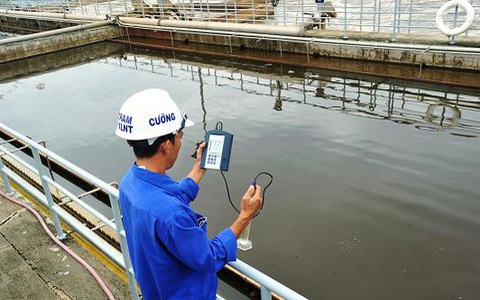
- Abstracting surface water of 10,000 m³/day or more to produce and supply clean water for domestic use: online monitoring at the intake point is mandatory, at least temperature, pH, DO, TSS, COD, ammonium and the other parameters stated in the permit; at a frequency of no more than once per hour, transmitted to the national water resources information system.
- Works built before 1 July 2024 must complete installation before 1 July 2026 (the deadline has passed).
- When online data is interrupted due to maintenance, calibration or equipment repair: monitor once every 3 days, with a remediation period of no more than 60 days; a transmission line interrupted for more than 72 hours must be reported in writing.
- Clean water suppliers below 10,000 m³/day: online water quality monitoring is encouraged.
- A plant that abstracts surface water itself for production: water quality is monitored according to the abstraction permit; the volume abstracted must be updated daily (online flow measurement is encouraged).
- Surface water abstraction for production (non-agricultural) of 100 m³/day or less: no registration and no abstraction permit required.
6. Construction investment: the new Law on Construction
Law on Construction No. 135/2025/QH15 and Decree 217/2026/ND-CP, effective from 1 July 2026, replace the 2014 Law on Construction and Decree 175/2024/ND-CP. Only the provisions on construction permit exemption and notice of commencement (clauses 2 and 3 of Article 43) apply from 1 January 2026.
| Content | Before 1 July 2026 (2014 Law as amended in 2020, Decree 175/2024) | From 1 July 2026 (Law 135/2025, Decree 217/2026) |
|---|---|---|
| Projects needing only an economic and technical report | Total investment of no more than VND 20 billion | Total investment of no more than VND 40 billion (excluding compensation, site clearance and land use fees). No appraisal by the specialised construction agency. |
| Pre-feasibility study report | National important projects, Group A projects using public investment capital, public-private partnership (PPP) projects, projects whose investment policy is approved by the National Assembly or the Prime Minister | Follows the laws on public investment, PPP and investment. Group A public investment projects include industrial park infrastructure projects (regardless of total investment) and water supply and drainage and waste treatment projects with total investment of VND 3,000 billion or more. Projects using enterprise capital: determined under the law on investment. |
| Appraisal of the feasibility study report at the specialised agency | Public investment and PPP projects; projects using other capital that are large in scale or include works with a major impact on safety and community interests | Keeps the public investment, PPP and large-scale business project groups; the list of works affecting safety and community interests (Appendix IV of Decree 217/2026) includes water supply and drainage works of Grade II or higher. |
| Construction permit exemption | Works whose implementation design after the basic design has been appraised | Applies from 1 January 2026. Works under a project whose feasibility study report has been appraised by the specialised construction agency and approved (and some other cases under Article 43). |
| Works inside industrial parks | No separate exemption | Still no separate exemption. The industrial park management board issues the construction permit; the time limit is 10 working days (previously 20 days). |
| When exempt from a permit | Send a notice of commencement with the design dossier | Applies from 1 January 2026. You must still send a notice of commencement with a dossier equivalent to the permit application dossier (excluding the application form). |
| Contractor capability | Organisations must hold a capability certificate | The capability certificate for organisations is abolished; organisations publicly declare their own capability. Individuals holding certain positions still need a practising certificate. |
Important note
Many advisory documents still cite a rule on “permit exemption for works inside industrial parks with a 1/500 detailed plan”. This rule is not in the Law on Construction as amended in 2020, nor in the new law. Whether a particular wastewater treatment plant is classed as a “Grade II drainage work” (subject to appraisal and exempt from a permit) depends on the scale and grading of the work; it must be determined separately for each project.
What to do
- For projects of up to VND 40 billion: prepare an economic and technical report, shortening procedures and preparation time.
- Determine the grade of the treatment plant works from the project preparation stage, to know whether the feasibility study report must be appraised and whether a permit exemption applies.
- For works inside industrial parks: prepare the permit dossier at the park management board in parallel with the environmental dossier.
7. Environmental permits, periodic reports, industrial clusters
Resolution 66.19/2026/NQ-CP of 18 May 2026, applying until the end of 28 February 2027 (or earlier if a replacement document is issued). See also the article Decree 48/2026: who no longer needs an environmental permit and NGO’s environmental permit service.
Who must hold an environmental permit while Resolution 66.19 applies
| Type of operation | Threshold for requiring a permit |
|---|---|
| Types with a high risk of causing pollution: textiles with a dyeing stage, leather tanning, paper with a pulp production stage, seafood processing, cassava starch, monosodium glutamate, cane sugar, rubber latex processing, basic inorganic chemicals, chemical fertiliser, cement with a clinker stage, coal-fired thermal power, etc.; industrial parks and clusters; solid waste treatment | Industrial wastewater requiring treatment from 100 m³/day, or emissions requiring treatment from 100,000 m³/hour |
| Hazardous waste recycling and treatment facilities; facilities importing scrap as production material | A permit is required (no threshold applies) |
| Other projects and facilities | Industrial wastewater requiring treatment from 150 m³/day, or emissions from 100,000 m³/hour |
Below the thresholds above, only an environmental registration is needed: at the provincial People’s Committee if wastewater requiring treatment is 50 m³/day or more or dust and emissions are 20,000 m³/hour or more; at the commune-level People’s Committee in the remaining cases (except exempt cases). Even where no permit is needed, wastewater and emissions must still meet the regulations.
Who issues the permit and the procedural changes
- The Chairman of the provincial People’s Committee issues permits for most subjects. The Ministry of Agriculture and Environment: hazardous waste recycling and treatment facilities operating in 2 or more provinces; scrap importing facilities. The Ministry of National Defence and the Ministry of Public Security: projects and facilities covered by state secrets on national defence and security.
- The procedure for exchange of a permit has been abolished (Law 146/2025/QH15, Decree 48/2026/ND-CP): renaming the project or facility or a change of owner only needs to be updated in the periodic environmental protection work report.
- Reissuance of permits is not carried out while Resolution 66.19 applies; a plant whose permit is about to expire in this period should ask the licensing agency early how it will be handled. Some procedures in the Resolution have their own application dates; pending dossiers should be checked against the guidance in Official Letter 7046/BNNMT-MT.
- Adding a plan for reuse, transfer or receipt of wastewater is a case that requires the permit to be adjusted.
Environmental protection work reports, hazardous waste
The annual report (period from 1 January to 31 December) is submitted before 15 January of the following year; infrastructure investors of industrial parks and clusters submit before 20 January. It may be submitted electronically. Hazardous waste may be stored at the facility for no more than 1 year from when it arises; if the period is exceeded because no suitable treatment unit has been found, an annual report must be made.
From 9 February 2026, determining whether a waste is hazardous follows QCVN 07:2025/BNNMT (Circular 44/2025/TT-BNNMT), which replaces QCVN 07:2009/BTNMT and QCVN 50:2013/BTNMT (hazardous thresholds for sludge from water treatment processes). A plant with wastewater treatment plant sludge, boiler ash and slag, or chemical residue should review its classification results against the new regulation when signing collection and treatment contracts.
Industrial clusters not required to build a centralised wastewater treatment plant
From 29 January 2026, an industrial cluster is not required to build a centralised wastewater collection and treatment system if its secondary facilities already have adequate treatment systems of their own and it falls under one of two cases: the cluster was operating before 1 January 2022 and is more than 80% occupied; or the total wastewater flow of the cluster (including secondary facilities) is below 100 m³/day.
What this means for plants
While the Resolution applies, the thresholds for requiring a permit are higher and dossiers are handled at provincial level. If within the next year a plant plans to increase capacity, change technology, increase discharge flow or add a water reuse plan, it should prepare the dossier early to submit before 28 February 2027. After this milestone, the rules may revert to what they were before or be replaced by a new document.
8. Greenhouse gases, the carbon market and CBAM
Decision 42/2026/QD-TTg of 10 August 2026 · Decree 06/2022/ND-CP (amended by Decrees 119/2025/ND-CP and 83/2026/ND-CP) · Decision 232/QD-TTg of 24 January 2025.
New list: 2,441 facilities required to carry out greenhouse gas inventories (effective 25 September 2026)
An increase of 275 facilities over the 2024 list (Decision 13/2024/QD-TTg). The list is reviewed and updated every 2 years: a plant not named this time may still be named at the next update after expanding production.
| Group | Number of facilities |
|---|---|
| Industry and Trade (industry, energy) | 1,916 |
| Construction | 411 |
| Agriculture and Environment | 61 |
| Transport | 53 |
Obligations of facilities on the list
- Facility-level greenhouse gas inventory every two years, sent to the provincial People’s Committee before 31 March (under the old list, the first period was in 2025 for 2024 data; on this cycle, the next period is expected before 31 March 2027). Thermal power, steel and cement plants that are allocated quotas have their own reporting schedule; a facility newly added to the list should ask the provincial Department of Agriculture and Environment to confirm its first reporting period.
- Emission mitigation plan for 2026–2030 (under the old list, the deadline for preparing it was 31 December 2025; a facility newly added to the list should ask the Department about the deadline that applies to it).
- Annual facility-level emission mitigation report, before 31 March, starting in 2027. This is a different report from the inventory report.
Why management should care
- The domestic carbon market (Decision 232/QD-TTg): pilot from 06/2025 to the end of 2028, formally operating from 2029. Emission quotas are allocated to the facilities on the inventory list; quotas for 2025–2026 have been allocated to 110 thermal power, steel and cement plants, and quotas for 2027–2028 are to be allocated before 31 October 2027. When the market operates, a facility emitting above its quota can buy additional quotas or carbon credits to offset, or invest in reducing emissions.
- Enterprises exporting to the EU (CBAM): from 1 January 2026, the EU Carbon Border Adjustment Mechanism enters its definitive period for iron and steel, aluminium, cement, fertiliser, electricity and hydrogen. EU importers (above the exemption threshold of 50 tonnes per year, which does not apply to electricity and hydrogen) buy CBAM certificates from 1 February 2027 for goods imported from 2026, and will ask Vietnamese suppliers to provide verified emission data.
- Customers with foreign direct investment (FDI) and supply chains increasingly ask for emission data in supplier assessments.
What to do
- Check the plant’s name in the appendix of Decision 42/2026/QD-TTg.
- Assign a focal person and standardise monthly data: electricity consumed, fuel (coal, oil, gas), raw materials, waste.
- Prepare the inventory report and the mitigation plan following the guidance of the sector’s managing ministry (see the facility-level greenhouse gas inventory procedure and NGO’s inventory and emission reduction services).
- Look for low-cost emission reductions: in a wastewater treatment plant there are usually two significant sources, the electricity for the air blowers and the methane from the anaerobic tank and biogas lagoon.
9. Best available techniques (BAT), packaging recycling, plastics
Best available techniques: apply to at least one production stage
Law on Environmental Protection Article 105; Decree 08/2022/ND-CP Article 53 and Appendix II (replaced by Decree 48/2026/ND-CP).
| Group of types with a risk of causing pollution (Appendix II) | Investment projects: before | Operating facilities: before |
|---|---|---|
| Level I: toxic minerals, metals; glass; metal production (except only rolling, drawing, casting from billets); paper with a pulp stage or using recycled material; basic inorganic chemicals, chemical fertiliser, plant protection products; textiles with dyeing, stone washing, yarn boiling; leather tanning; oil and gas, petrochemical refining; coal-fired thermal power; coke, coal gasification | 1 January 2030 | 1 January 2031 |
| Level II: recycling and treatment of solid waste and hazardous waste; ship breaking; scrap import; production with a metal plating stage; batteries, accumulators; cement with a clinker stage | 1 January 2031 | 1 January 2032 |
| Level III: rubber latex processing; cassava starch, monosodium glutamate; beer, carbonated soft drinks, spirits; industrial alcohol; cane sugar; seafood processing; livestock and poultry slaughter; livestock farming; electronic products and electrical equipment with plating, coating or chemical cleaning stages | 1 January 2032 | 1 January 2033 |
Each type has its own capacity threshold in Appendix II; some small-scale types are not on the list. The list above is a summary and must be checked against the original text.
Recycling responsibility of producers and importers (EPR): Decree 110/2026, effective 25 May 2026
- Applies to the packaging of food, cosmetics, medicines, fertiliser, animal feed, veterinary medicines, detergents, cement and other product groups (batteries, accumulators, lubricating oil, tyres and tubes, electrical and electronic products, etc.). Revenue from these products below VND 30 billion per year is exempt from the packaging recycling obligation.
- Some mandatory recycling rates: paper and carton packaging 20%; rigid PET 22%; rigid HDPE, LDPE, PP, PS 15%; flexible plastic 10%; aluminium 22%; glass 15%.
- Each year, choose one of two ways: organise recycling yourself, then register the plan and report results before 1 April; or make a financial contribution to the Vietnam Environment Protection Fund, then declare before 1 April and pay before 20 April. Recycling rates rise for the first time in 2029 (each increase no more than 10%, on a 3-year cycle).
Plastics
- From 1 January 2026: no production or import of hard-to-biodegrade plastic bags smaller than 50 × 50 cm and with a single-layer film thickness of less than 50 µm (except for export goods and bags used to package goods being sold).
- After 31 December 2030: production and import stop for single-use plastic products, hard-to-biodegrade plastic packaging and products containing microplastics. Main exceptions: production for export; packaging used to package products and goods sold on the market; products with the Vietnam eco-label.
10. Self-check table and year-by-year plan
A 15-minute self-check
| Question | If yes |
|---|---|
| Does the wastewater receiving water body fall under Column A, B or C; is the discharge flow above or below 2,000 m³/day? | Determine the applicable QCVN 40:2025 limits (section 2). |
| Are the effluent COD and TSS over the last 12 months within the QCVN 40:2025 limits? | If close to or above them, an upgrade plan is needed before 2032. |
| Does the plant have its own domestic wastewater treatment system, or is it a livestock farm? | Check against QCVN 14:2025 or QCVN 62:2025 (section 3). |
| Does the plant have boilers, incinerators or kilns? | Check against QCVN 19:2024 (waste incinerators: QCVN 30:2025); ask whether the province has a roadmap earlier than 2032 (section 4); see the automatic emission monitoring thresholds (section 5). |
| Has the noise and vibration at the plant boundary been measured against the new regulations? | Must comply from 1 January 2027. |
| Does the wastewater or emission flow rate in the permit fall under automatic monitoring? | See the two tables in section 5. |
| Does the plant have sludge, ash and slag, or chemical residue? | Classify hazardous waste under QCVN 07:2025; store for no more than 1 year (section 7). |
| Is the plant on Appendix II, and at which level? | Prepare a plan to apply BAT before 2031–2033 (section 9). |
| Is a new or expanded treatment plant planned? | Determine the total investment and the grade of the works to choose the procedure under the new Law on Construction (section 6). |
| Does the environmental permit need to be adjusted in the next 12 months? | Submit the dossier before 28 February 2027 (section 7). |
| Is the plant named on the Decision 42/2026 list; does it export iron and steel, aluminium, cement or fertiliser to the EU? | Carry out the greenhouse gas inventory and reporting; prepare emission data (section 8). |
| Does the enterprise produce or import packaged goods (food including beverages, cosmetics, medicines, etc.) with revenue from these products of VND 30 billion per year or more? | Carry out EPR: register or declare before 1 April each year (section 9). |
Suggested plan by year
| Period | What to do |
|---|---|
| Q4 2026 | Measure noise and vibration against QCVN 26 and 27:2025; review the permit and monitoring thresholds; compare monitoring data with the new regulations; check the greenhouse gas list. |
| 2027 | Meet noise and vibration limits from 1 January; environmental protection work report before 15 January; submit the permit adjustment dossier (if needed) before 28 February; emission mitigation report and greenhouse gas inventory (if due) before 31 March; EPR before 1 April; assess the existing wastewater and emission treatment plants. |
| 2028–2029 | Put wastewater and emission treatment upgrades and BAT into the investment plan, doing them together with a production expansion if there is one; prepare for the formal carbon market (2029). |
| 2030–2033 | Complete BAT by level (before 2031, 2032, 2033); complete renovation, stable operation and monitoring that proves compliance with the new regulations before 1 January 2032. |
Talk to an NGO engineer
Want to check your plant or farm against the milestones above? Send your process flow diagram and latest monitoring results; an NGO engineer will make an initial assessment of how well you meet the new standards and which items need upgrading.
Main legal bases
- Law on Environmental Protection 2020, amended by Law No. 146/2025/QH15;
- Decree 08/2022/ND-CP, amended by Decrees 05/2025/ND-CP, 48/2026/ND-CP and 110/2026/ND-CP (Consolidated Document 49/VBHN-BNNMT); Circular 02/2022/TT-BTNMT (as amended);
- Circulars 06/2025/TT-BTNMT (QCVN 40:2025), 05/2025/TT-BTNMT (QCVN 14:2025), 04/2025/TT-BTNMT (QCVN 62:2025), 45/2024/TT-BTNMT (QCVN 19:2024), 01/2025/TT-BNNMT (QCVN 26 and 27:2025), 44/2025/TT-BNNMT (QCVN 07:2025), 45/2025/TT-BNNMT (QCVN 30:2025);
- Decree 346/2025/ND-CP on environmental protection fees on wastewater; Decree 153/2024/ND-CP on environmental protection fees on emissions; Resolution 66.19/2026/NQ-CP;
- Law on Construction No. 135/2025/QH15, Decree 217/2026/ND-CP;
- Law on Water Resources 2023, Decree 53/2024/ND-CP amended by Decree 23/2026/ND-CP;
- Decision 42/2026/QD-TTg; Decree 06/2022/ND-CP amended by Decrees 119/2025/ND-CP and 83/2026/ND-CP; Decision 232/QD-TTg;
- Regulation (EU) 2023/956 on CBAM, amended by Regulation (EU) 2025/2083.
A summary of the legal documents in force up to October 2026, for reference. The Government has submitted to the National Assembly a draft amended Law on Environmental Protection (Submission 701/TTr-CP of 17 September 2026); when the new law is passed, some content may change. When preparing dossiers, check the original text of the documents.