Tiếng Việt
 中文 (中国)

Industrial slaughtering faces a silent but very costly “pain point”: wastewater. Every day, hundreds of cubic metres of thick, foul-smelling slaughterhouse wastewater full of grease and bacteria are not only a direct threat to the environment but also a financial burden and a legal risk for your business.
Are you struggling with a treatment system that is not effective, sky-high operating costs, or worry about surprise inspections by the authorities? It is time to turn this challenge into a controlled process. At NGO International, with more than 20 years of experience, we do not just supply a system; we bring peace of mind and a sustainable solution.
1. Composition and properties of slaughterhouse wastewater
Every stage of the livestock and poultry slaughtering process uses water, at a rate of about 5 – 15 m³ per tonne of livestock, and almost all of this water becomes wastewater. The main discharge sources are:
- Wastewater from the slaughtering process
- Wastewater from cleaning equipment in the facility and from the pens
- Domestic wastewater from the facility’s workers
The pollution profile of slaughterhouse wastewater is far beyond that of many other industries, as shown by the following indicators:
| Pollution Indicator | Typical Concentration | Impact & Technical Challenges |
| BOD₅ (Biochemical Oxygen Demand) | 1,500 – 20,000 mg/L | Extremely high; depletes oxygen in the water and causes mass deaths of aquatic organisms. Requires large-capacity biological treatment technology. |
| COD (Chemical Oxygen Demand) | 3,000 – 40,000 mg/L | Indicates the total amount of hard-to-degrade organic matter. Advanced treatment stages are needed to remove it thoroughly. |
| TSS (Total Suspended Solids) | 1,000 – 3,000 mg/L | Includes blood, manure, meat scraps… clogs pipes, reduces the efficiency of biological treatment and produces large amounts of sludge. |
| Animal fats and grease | 500 – 8,000 mg/L | Clogs the system and forms a scum layer that blocks oxygen exchange, seriously affecting the treatment microorganisms. |
| Total Nitrogen (T-N) & Total Phosphorus (T-P) | High | Causes eutrophication of the receiving water body, triggers toxic algal blooms and destroys the ecosystem. |
| Pathogenic microorganisms (Coliform, E.coli) | Very high density | A source of dangerous disease outbreaks for the community if not thoroughly disinfected. |

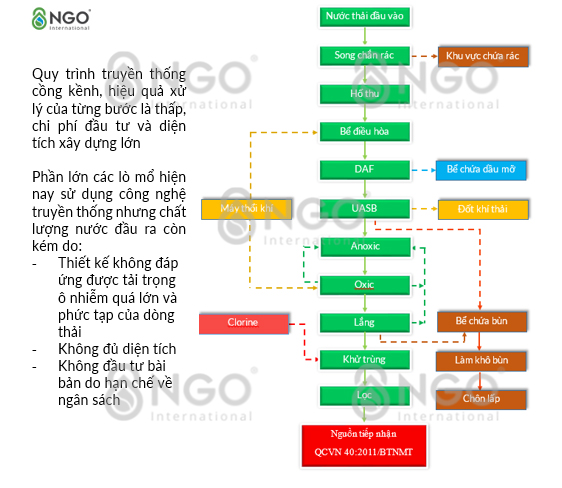
2. Common slaughterhouse wastewater treatment process today
3. Is NGO’s slaughterhouse wastewater treatment solution better?
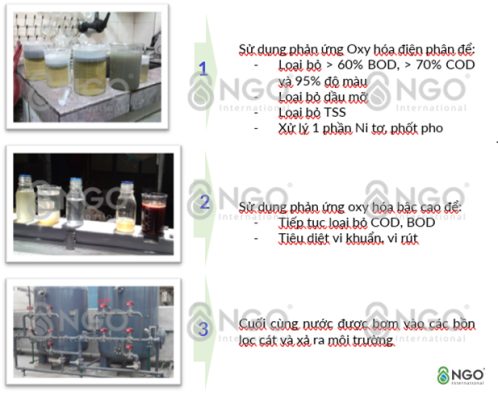
We can simplify the wastewater treatment process with high efficiency. Here is a successful example:
| Wastewater before treatment | Water quality after treatment |
| COD ~ 40,000 – 50,000 ppm | COD <300 ppm |
| BOD ~ 20,000 ppm | BOD < 900 ppm |
| TSS ~ 2000- 3000 ppm | TSS < 500 ppm |
| Oil and grease ~ 8000 | Oil and grease < 100 ppm |
“Since working with NGO International, we have genuinely had peace of mind. Their slaughterhouse wastewater treatment system not only runs stably and effectively, but the technical team is also very professional and supportive. Operating costs have dropped noticeably. It is a worthwhile investment.”
– Mr. N.V.A, Managing Director
4. Frequently asked questions
The cost depends on several factors: the slaughterhouse wastewater flow (m³/day), the inlet pollution level, and the required effluent quality (Column A or B). NGO International will provide a detailed, optimised quotation after a real site survey of your facility.
We prioritise highly automated solutions that minimise human intervention. NGO International will train your team and transfer the technology thoroughly until they can operate it proficiently.
Usually 3-6 months, depending on the scale and complexity of the works, including the design, construction and trial operation stages.
Yes. Depending on the specific requirements and the treatment level, slaughterhouse wastewater that has passed through NGO’s system can meet the standard for reuse for purposes such as watering plants on the farm grounds and washing pens (after additional disinfection), saving clean water.
Sludge from NGO’s system, especially sludge from the primary settling tank and excess biological sludge, has a high organic and nutrient content. We encourage and advise solutions that turn the sludge into high-quality compost fertiliser, recycling resources and reducing waste treatment costs.
See more : https://ngoenvironment.com/en/solution.html
For detailed advice on slaughterhouse wastewater treatment solutions, please call +84 24 7300 0890 or email office@8ngo.com.

Talk to an NGO engineer
Free survey and consultation. Send us your wastewater type (industrial or domestic), flow rate (m³/day), influent analysis results if available and required effluent quality; an NGO engineer will propose a suitable technology and a realistic quotation.
Offices in Hanoi and Ho Chi Minh City · +84 24 7300 0890 · office@8ngo.com
***Please read the Terms of Use – Copyright carefully before copying or quoting any content or images from this website.
This website is copyrighted by NGO International Co., Ltd. Any use or reproduction of part or all of its content in any form is strictly prohibited without our express written permission.