Tiếng Việt
 中文 (中国)

From 1 September 2025, the new national technical regulation on industrial wastewater — QCVN 40:2025/BTNMT — officially takes effect, replacing QCVN 40:2011, which was in use for more than 14 years. The way discharge limits are calculated changes fundamentally, and many parameters become stricter. For most factories operating a wastewater treatment system, now is the time to review the effluent before the inspection team comes knocking.
What does this regulation change?
QCVN 40:2025/BTNMT was issued together with Circular 06/2025/TT-BTNMT dated 28 February 2025 and takes effect from 1 September 2025. This regulation consolidates and replaces 11 former regulations, including QCVN 40:2011 (industrial wastewater), QCVN 28:2010 (healthcare wastewater), QCVN 25:2009 (landfills), QCVN 29:2010 (petroleum depots), as well as the sector-specific regulations for rubber, seafood, paper and pulp, textile dyeing, fuel ethanol, cassava starch and steel.
The three biggest changes that the technical team needs to know:
- The regional coefficient and flow coefficient (Kq, Kf) are removed. Previously, discharge limits were multiplied by these coefficients; they are now absolute limit values, which are easier to apply but also harder to “get around”.
- Column C is added and the limits in Column A and Column B are lowered. The regulation is graded by the sensitivity of the receiving water body, with stricter limits for sources that need protection.
- For the first time, TOC (total organic carbon) is allowed in place of COD — a more modern and more accurate measurement method.
On the receiving water body: Column A applies to sources that require strict protection or serve domestic water supply; Column B to ordinary receiving water bodies; Column C to sources with lower requirements. Columns A/B refer to Levels A/B of QCVN 08:2023/BTNMT on surface water quality.
One practical note: if the discharge zone has not yet been determined, the enterprise applies Column B.
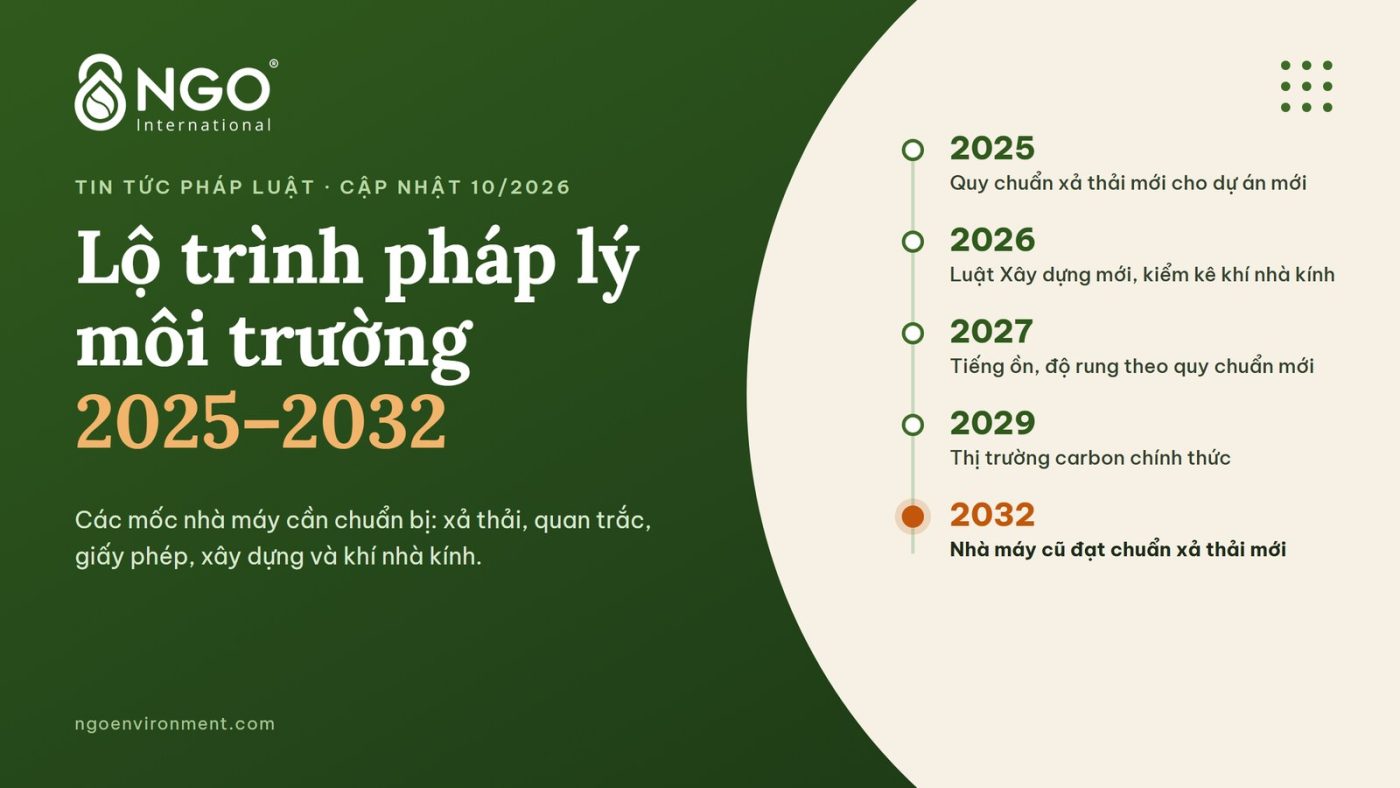
An important transitional milestone: facilities already in operation, or projects whose EIA/environmental permit was approved before 1 September 2025, may continue to apply the old regulation until the end of 31 December 2031 and must meet QCVN 40:2025 from 1 January 2032. However, new projects, and expansion or capacity-increase projects that submit their dossiers after 1 September 2025, must apply it immediately.
Who is affected?
The regulation applies to every facility that discharges industrial wastewater into a receiving water body.
The most clearly affected are the sectors with hard-to-treat wastewater and high pollution loads: textile dyeing, paper and pulp, electroplating, chemicals, seafood processing — and now also hospitals and healthcare facilities, since they have been integrated into the common regulation.
In addition to the basic parameters (BOD, COD, TSS…), QCVN 40:2025 also sets pollutant parameters specific to each industry, so a system designed to the old standard may no longer be sufficient to meet the new limits.
What should enterprises do?
- Determine whether your facility is subject to immediate application or is in the transitional period until 31 December 2031 — this decides your investment roadmap.
- Sample your current effluent and compare it with the new limits under the correct Column (A/B/C) that corresponds to your factory’s receiving water body.
- Re-evaluate the technology: if the effluent does not yet comply, consider upgrading/retrofitting (adding biological and physico-chemical treatment stages, colour removal, nitrogen removal…) or water recirculation and reuse options to reduce the discharge load.
- Update the environmental records and the monitoring programme to match the new parameters, especially the industry-specific parameters.
- For new projects: build the QCVN 40:2025 requirements in from the design stage so the system does not have to be modified after construction.
Risks of late compliance
Discharging wastewater above the technical regulation is an act subject to administrative penalties under Decree 45/2022/ND-CP, with fines that can reach from hundreds of millions up to 1–2 billion VND depending on severity, together with additional measures such as suspension of operations and mandatory remediation.
From 1 January 2026, enterprises also bear an environmental protection fee on wastewater under Decree 346/2025/ND-CP, calculated on the actual volume and pollution level — the better the treatment, the lower the fee payable.
NGO accompanies enterprises
QCVN 40:2025 is not only a compliance challenge, but also an opportunity to optimise operating costs if the upgrade is done in the right direction. NGO International provides consulting, design, retrofitting and operation of wastewater treatment systems that meet QCVN, while optimising chemical and electricity costs.
Register for a free assessment of your current system to find out how far your system is from the new limits and what needs to be upgraded.