Tiếng Việt
 中文 (中国)

Solution summary
| Suitable for | Meat, seafood, dairy, beverage, starch and confectionery processing plants |
|---|---|
| Technology | DAF flotation with over 90% solid–liquid separation, physico-chemical treatment, UASB, aerobic treatment or MBR |
| Effluent | Meets QCVN 40:2025/BTNMT or the industrial park’s connection limits; water reuse when needed |
| Footprint | About 0.38–0.49 m² per m³ of wastewater (data from completed projects) |
| Operation | Level of automation tailored to your needs, reducing staffing and operating costs |
| Scope | Turnkey design, equipment, construction and commissioning; FAT and SAT records at handover |
| Featured project | Food plant in VSIP 3 Industrial Park, former Binh Duong province (now part of Ho Chi Minh City), in 2025 |
| Recognition | Top 100 Green and Sustainable Development Enterprises 2023 (view certificate) |
Free site survey and consultation. Talk to an NGO engineer via Zalo or hotline +84 969 867 924 – we respond right away.
Food plants rarely struggle because of one unusual pollutant; the difficulty lies in oil and grease, high organic content and loads that change from shift to shift and season to season. NGO International Co., Ltd (NGO International), an industrial wastewater treatment contractor with offices in Hanoi and Ho Chi Minh City, has delivered treatment stations for several plants in the sector, including a food plant in VSIP 3 Industrial Park in the former Binh Duong province (now part of Ho Chi Minh City). This article covers the characteristics of the wastewater, NGO’s approach and real projects.
Overview of food industry wastewater treatment
Wastewater in a food plant comes from washing raw materials, processing, heating and equipment cleaning, with water use of about 5–15 m³ per tonne of product. Its composition varies with the product – meat, seafood, dairy, beverages, starch or confectionery – but a few features are common: high COD and BOD, mostly from readily biodegradable organic matter; large amounts of oil, grease and suspended solids; and pH that varies from one process stage to the next.
Output that follows the seasons and incoming orders makes flow and concentration change over short periods, shock-loading the biological system. Line cleaning water (CIP) also carries detergents and surfactants that biological treatment handles poorly. On top of that comes odour, generated when wastewater decomposes anaerobically right in collection pits and holding tanks, affecting both production and the surrounding residential areas.
The design must therefore be based on flow and concentration data measured over many shifts, the BOD/COD ratio, oil and grease content, available land, and discharge or reuse requirements. Plants inside an industrial park must also meet the park’s connection limits, which usually differ from the regulations for discharge into a receiving water body.
NGO International’s capabilities in food industry wastewater treatment
For food and beverage companies, NGO International provides turnkey wastewater treatment, from design, equipment supply and construction to commissioning, with FAT and SAT quality records at handover. Materials, chemicals and technical support are supplied locally; equipment is selected from models available in Vietnam to ensure continuous operation. Within the same agriculture and food group, NGO has a dedicated solution for livestock wastewater.
At the head of the line, a high-rate DAF flotation unit withstands inlet fluctuations, including during CIP cleaning, with solid–liquid separation efficiency above 90%. Data compiled from completed projects show a construction footprint of about 0.38–0.49 m² per m³ of wastewater. A large food company, after setting strict criteria for water quality and operating consumption, assessed that NGO had proven the quality of its design and operation. See also solutions for the food and beverage industry.
Featured projects by NGO International
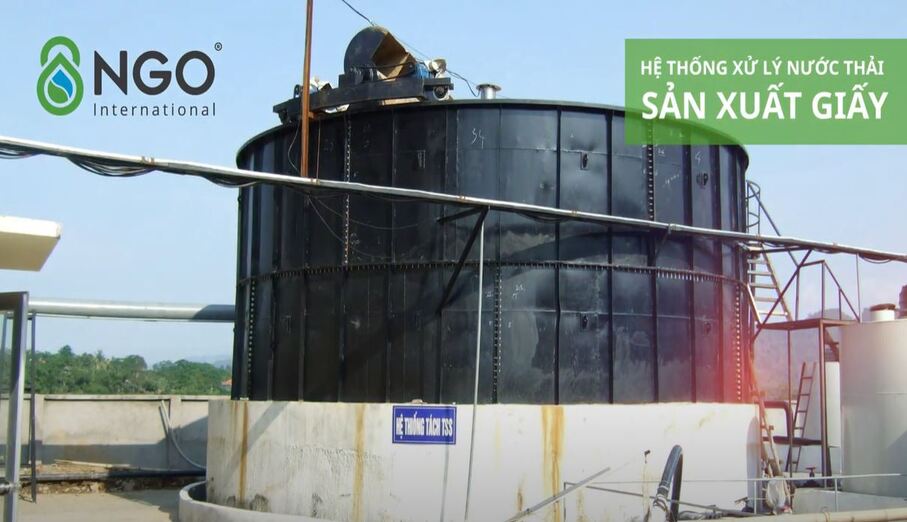
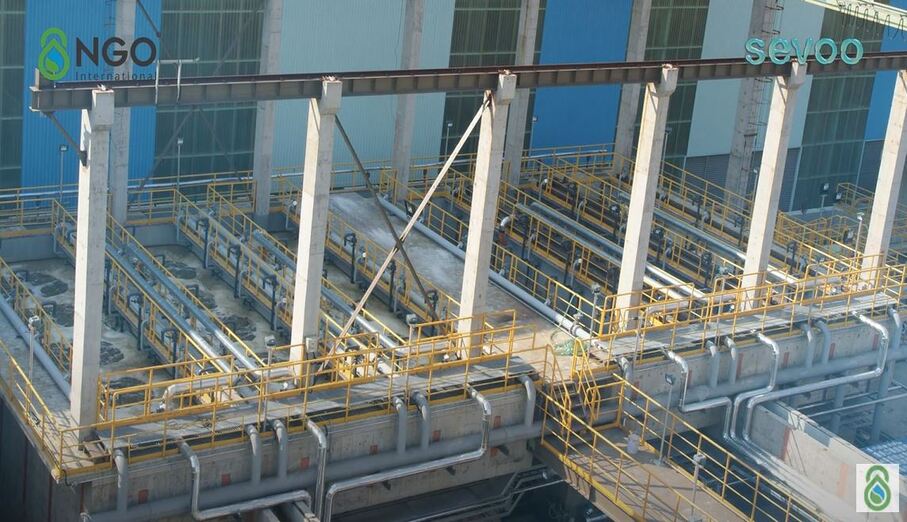
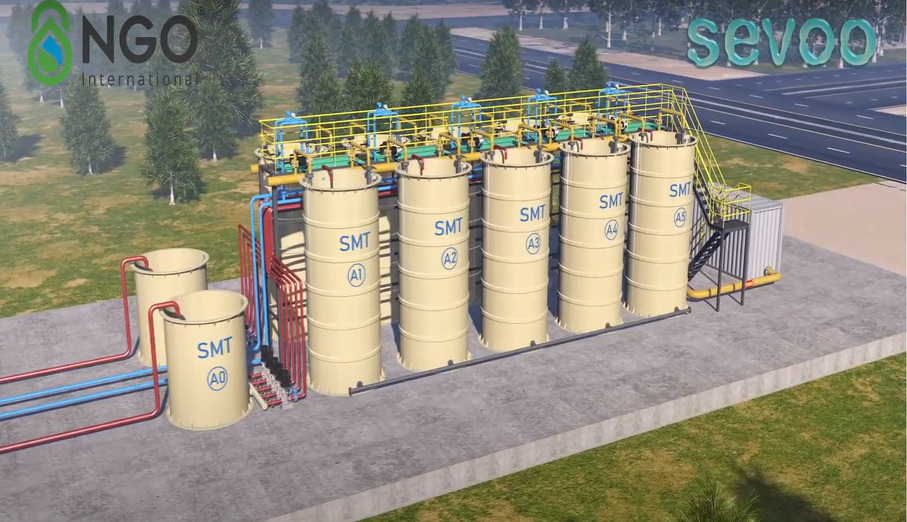
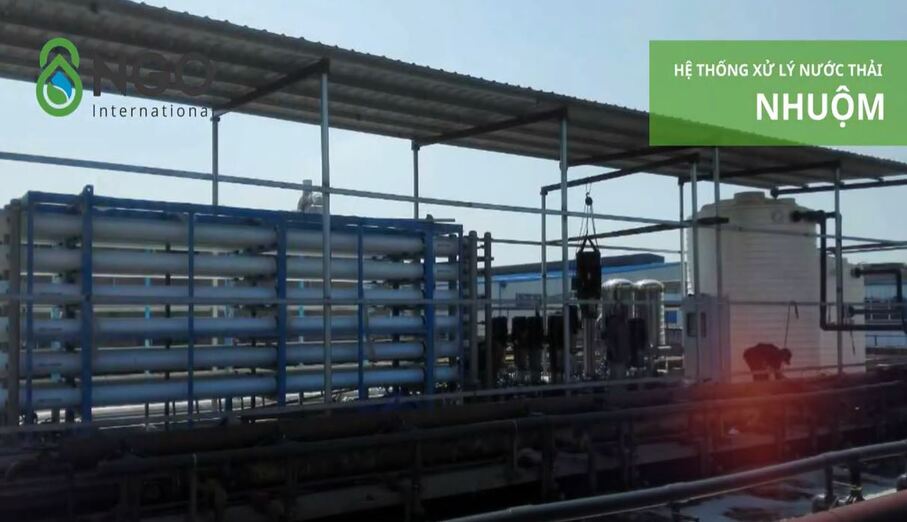
The first two stations appear in the video at the top of this article; the third case is based on client feedback published on our Projects page (in Vietnamese). Company names are not disclosed in these examples.
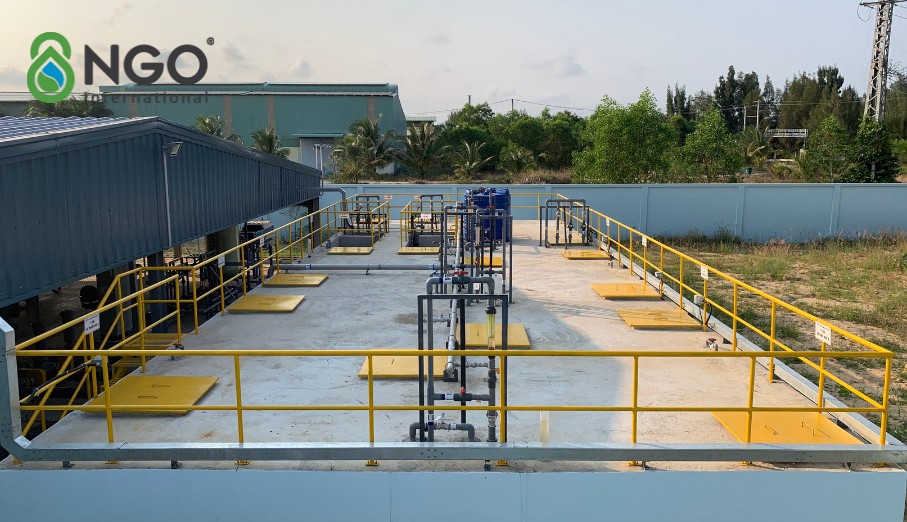
Food plant wastewater treatment station in VSIP 3 Industrial Park, Binh Duong (now part of Ho Chi Minh City)
| Location | VSIP 3 Industrial Park, former Binh Duong province (now part of Ho Chi Minh City) |
|---|---|
| Industry | Food processing |
| NGO’s scope | Construction, installation, completion, sampling |
| Year | 2025 |
- The challenge
The plant is located in VSIP 3 Industrial Park, so its treated water must meet the connection limits of the park’s centralised treatment plant before discharge.
- NGO’s solution
The civil works were completed first, followed by installation of pumps, piping, electrical panels and chemical tanks. The process flow diagram was adjusted to the wastewater characteristics and the plant’s operating requirements.
- NGO’s role
NGO International carried out the civil construction, equipment installation and completion of the wastewater treatment station for this food plant in VSIP 3 Industrial Park (former Binh Duong province) in 2025.
- Results / value delivered
After completion, the treated water was sampled for rapid on-site testing and laboratory analysis, providing the basis for the operating phase.
Food wastewater treatment system with grease removal, physico-chemical treatment and UASB
| Industry | Food processing |
|---|---|
| Technology | Grease removal, physico-chemical treatment, UASB, aerobic treatment, disinfection |
| NGO’s scope | Construction, installation, completion |
| Effluent quality | Meets QCVN 40:2011/BTNMT |
- The challenge
The wastewater is rich in oil, grease and organic matter and has a fluctuating pH, so a multi-stage treatment line is needed to achieve stable effluent.
- NGO’s solution
Wastewater flows to a collection pit and an equalisation tank, then to a physico-chemical reaction tank, where NaOH adjusts the pH while PAC and polymer coagulate suspended particles that settle poorly. After physico-chemical settling, the water passes to the UASB, the aerobic tank, biological settling and disinfection. The station also has a flotation tank for grease removal and a sludge holding tank.
- NGO’s role
NGO International carried out the civil construction, equipment installation and completion stages of the system.
- Results / value delivered
The treated water meets QCVN 40:2011/BTNMT, the industrial wastewater regulation in force before QCVN 40:2025/BTNMT took effect. Removing grease and solids at the start helps the UASB and the aerobic tank run more stably.
Construction of wastewater and exhaust gas treatment systems for a food plant in Southern Vietnam
| Region | Southern Vietnam |
|---|---|
| Industry | Food |
| NGO’s scope | Construction of wastewater and exhaust gas treatment |
| Status | Accepted and handed over |
- The challenge
The plant needed two work packages built within the same project: wastewater treatment and exhaust gas treatment.
- NGO’s solution
Both packages were assigned to a single contractor, which the project owner evaluated and selected from the tendering stage.
- NGO’s role
NGO International was the construction contractor for the wastewater and exhaust gas treatment systems at this food plant in Southern Vietnam, from implementation through to acceptance and handover.
- Results / value delivered
According to the project owner’s representative, the project was completed on schedule with no cost overruns and has been accepted and handed over for use.
Wastewater treatment technologies commonly used in the food industry
Removing grease and solids at the head of the line is the most important decision. A flotation tank or DAF unit uses fine air bubbles to lift grease and suspended solids to the surface, where they are skimmed off; if grease goes straight into the biological tank, it coats the sludge, hinders oxygen transfer and causes sludge flotation.
A mixed equalisation tank keeps the wastewater homogeneous and limits odour. When the wastewater contains surfactants from CIP or fine solids, coagulation–flocculation with PAC and polymer helps reduce the load ahead of the biological stage.
UASB provides anaerobic treatment and suits high-COD, readily biodegradable wastewater; the reactor needs stable pH and temperature and little grease, so it is placed after the grease removal stage. Anaerobic treatment produces less sludge than aerobic treatment, which also lowers sludge handling costs. The remaining COD and nitrogen are treated further in the aerobic stage – activated sludge, AAO or MBBR depending on effluent requirements; plants that want to reuse water can replace the aerobic stage with MBR.
Food industry wastewater treatment in Binh Duong (Ho Chi Minh City)
Since 2025, the former Binh Duong province has been part of Ho Chi Minh City. The area is home to many large industrial parks, where food and beverage plants discharge wastewater into the park’s centralised treatment plant and must meet the connection limits set by the park management board.
For plants inside an industrial park, such as the VSIP 3 project above, the park’s connection limits are the requirement that determines the treatment scheme. The equalisation tank must be large enough that the water sent to the centralised plant stays within the limits, even at peak hours or during CIP cleaning.
Water reuse is also increasingly being considered in the South: the Mekong Delta faces saltwater intrusion in the dry season, the Central Highlands are short of water, and international retail and FMCG groups require their suppliers to report water consumption. NGO’s Ho Chi Minh City office enables it to supply materials and technical support to plants in the South.
Besides the former Binh Duong province, NGO International takes on wastewater treatment for food and beverage processing plants in the locations below. Long An and Dong Nai have many agricultural and food processing plants around Ho Chi Minh City; in Northern Vietnam, Hanoi and Hung Yen have many food and beverage facilities in their industrial parks.
Where we work: food and beverage wastewater
Northern Vietnam: Hanoi, Hung Yen
Southern Vietnam: Binh Duong (now part of Ho Chi Minh City), Ho Chi Minh City, Long An (now part of Tay Ninh), Dong Nai
Why choose a contractor with hands-on experience?
Food wastewater is often designed from generic data tables that ignore the realities of the plant. A quick test is to give the contractor your plant’s worst-case scenario, such as a peak-season day that coincides with CIP cleaning, and ask how the treatment scheme would cope. An answer based on data measured over many shifts and seasons is more reliable than a generic parameter table.
Next come the approach to oil, grease and odour, how well the technology suits the existing operating team, the ability to supply equipment and materials available in Vietnam, and after-handover services, such as operation consulting when the system performs poorly. A station that meets the standards on acceptance day but becomes unstable after a few months usually shows that the design did not account for load fluctuations.
Cost and process for a food wastewater treatment station
The cost of a food wastewater treatment station depends mainly on the plant’s flow, pollutant concentrations, effluent requirements and available land, so two plants of the same capacity can still require very different levels of investment. The information below helps NGO engineers propose a solution and provide a realistic quotation; plants without analysis results can book a visit for NGO engineers to survey the plant and take samples on site.
Request a quotation and work with NGO
| Flow | m³/day, peak-hour and seasonal flow |
|---|---|
| Wastewater quality | COD, BOD, TSS, oil and grease, pH analysis results (if any) |
| Production | Main products, CIP cleaning schedule |
| Effluent requirements | Connection to the industrial park, discharge into a receiving water body or water reuse |
| Site | Area available for the station; new build or upgrade of an existing system |
| Location | Province, industrial park (if any) |
- Send your information
Send the information above via Zalo or hotline +84 969 867 924; an NGO engineer will respond right away.
- Initial consultation
An NGO engineer discusses the wastewater characteristics, effluent requirements and a suitable technology direction with you; consultation is free.
- Site survey and sampling
NGO engineers visit the plant to measure flow, sample wastewater over several shifts and inspect the site and existing system; the survey is free.
- Proposal and quotation
Process flow diagram, site layout and quotation based on the plant’s actual data.
- Implementation, construction and handover
Turnkey delivery from design, equipment supply and construction to commissioning, with FAT and SAT records at handover; operation consulting is available after handover when needed.
Frequently asked questions
NGO International carried out the construction, installation and completion of a wastewater treatment station for a food plant in VSIP 3 Industrial Park, former Binh Duong province (now part of Ho Chi Minh City), in 2025.
Yes. Besides the station in the former Binh Duong province, the company has built wastewater and exhaust gas treatment systems for a food plant in Southern Vietnam, which were accepted and handed over on schedule with no cost overruns.
Typically a sequence of grease removal or DAF, equalisation, physico-chemical treatment, anaerobic (UASB) and aerobic biological treatment, followed by settling and disinfection. The configuration depends on the raw materials and effluent requirements.
In Southern Vietnam, besides the station already built in VSIP 3 Industrial Park (former Binh Duong province), NGO takes on projects in Ho Chi Minh City, Long An (now part of Tay Ninh) and Dong Nai; in Northern Vietnam, in Hanoi and Hung Yen.
Grease coats the biomass, hinders oxygen transfer and causes sludge flotation, reducing the efficiency of both anaerobic and aerobic tanks.
No. UASB is effective for wastewater with high COD, good biodegradability and little grease; wastewater with low COD or a high share of poorly biodegradable substances is usually not suited to UASB.
It depends on the treatment scheme and capacity. Based on data from NGO’s completed projects, each m³ of wastewater requires about 0.38–0.49 m² of construction area.
Odour usually arises when wastewater decomposes anaerobically in collection pits and holding tanks. Shorten the time water stays in these tanks, mix the equalisation tank, remove grease early, and cover the units that generate odour and collect their air.
Conclusion
With food wastewater, what you need to design for is variability: loads change with the seasons, and oil, grease and detergents make the biological system hard to stabilise. The treatment scheme must therefore start with removing grease and solids and balancing the load, and only then move on to the biological stages.
From the station for a food plant in VSIP 3 Industrial Park (former Binh Duong province) to a system with grease removal, physico-chemical treatment and UASB, NGO International has worked with many types of wastewater in the sector, especially in Southern Vietnam. Plants that need a survey or a review of their system can book NGO’s technical team to take samples on site.
Talk to an NGO engineer
Free site survey and consultation. Send us your flow and wastewater analysis results (if any); an NGO engineer will respond right away and propose the next step for your plant.