Tiếng Việt
 中文 (中国)
In Hanoi, many factories, buildings and residential blocks cannot connect to a centralised treatment plant, yet they still have to treat their domestic wastewater to the technical regulations before discharging it into the drainage system. A decentralised station installed underground at each site is a common solution. NGO International Co., Ltd (NGO International), a Hanoi-based environmental company specialising in water and wastewater treatment, has built such a station for Carlsberg Vietnam in Hanoi, and has also supplied MBR membranes and provided several years of operation support for a factory’s wastewater treatment plant.
Overview of domestic wastewater treatment
Domestic wastewater comes from toilets, kitchens, laundry and bathing, and consists mainly of organic matter, suspended solids, nitrogen, phosphorus and microorganisms, so biological treatment is the foundation. It sounds simple, but many systems fail on ammonium and total nitrogen: ammonium has to be nitrified in an aerobic tank with a sufficiently long sludge age, while total nitrogen also requires an anoxic stage for denitrification.
In urban areas, the difficulties lie more in space and construction than in technology: limited land, existing structures, neighbours sensitive to odour and noise, and excavating tanks in densely populated areas requires careful planning of working hours, safety and transport. That is why the decentralised model, installed underground at each site, is considered instead of a centralised plant.
When choosing a solution, consider the daily and peak-hour flows, where an underground tank can be placed, the discharge point and the applicable regulation, and the level of system automation needed to reduce operating staff.
NGO International’s capabilities in domestic wastewater treatment
Based in Hanoi, NGO International delivers domestic wastewater treatment through three groups of solutions: decentralised underground stations, MBR membrane systems (the MBR-X line and the SMC module) and the SmartB biofilm solution developed by NGO. The scope covers survey, design, tank construction, equipment installation in the underground pit, connection, sampling and testing, and operation support.
After installation, NGO guides and trains the client’s operating staff; for systems that are performing poorly, NGO’s operation consulting service reviews and readjusts the operating procedures. Outside Hanoi, a service-sector investor in Da Nang has chosen a water treatment solution supplied by NGO.
NGO International’s featured projects
The first project is the underground station for Carlsberg Vietnam in Hanoi, one of three projects using the same model shown in the video at the top of this article. The second project is covered by client feedback on our Projects page (in Vietnamese); the name of this company is kept confidential.
Underground domestic wastewater treatment station for Carlsberg Vietnam – Hanoi Branch
| Client | Carlsberg Vietnam Brewery Co., Ltd – Hanoi Branch |
|---|---|
| Location | Hanoi |
| Model | Decentralised underground station |
| NGO’s scope | Survey, tank construction, installation, testing |
| Water source | Domestic wastewater |
- The challenge
Domestic wastewater had to be treated on site without taking up additional land on the premises.
- NGO’s solution
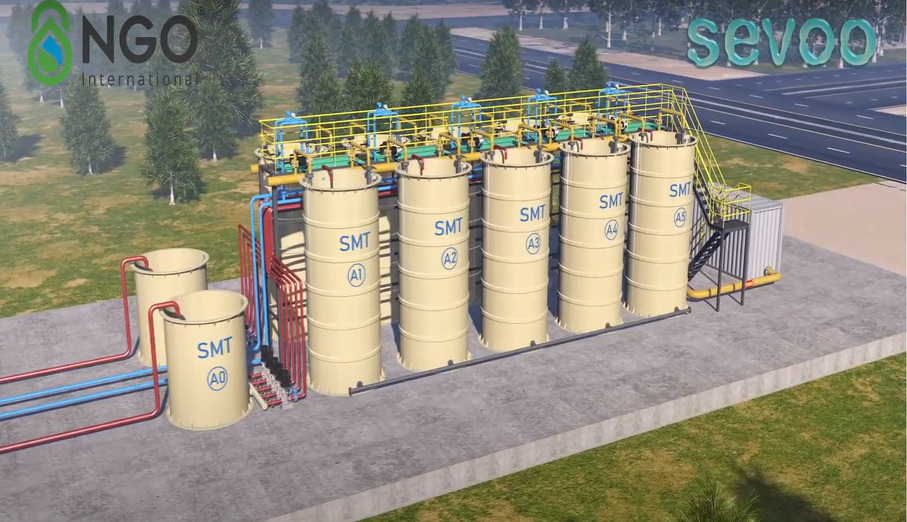
An underground station beneath the site, with only a small station house and access covers above ground. The tanks were built in place, the equipment was lowered into the underground pit and connected to the existing drainage system; the site was reinstated after construction.
- NGO’s role
NGO International surveyed the site, presented the solution to the project owner, built the tanks, installed the equipment and took samples for testing at the station.
- Results / value delivered
After completion, the effluent was sampled on site and a test result report was issued. The ground surface was returned almost to its original condition, with only the station house and access covers remaining.
MBR membrane supply and operation support for a factory’s wastewater treatment plant
| Product | MBR membranes |
|---|---|
| NGO’s scope | Membrane supply, operation consulting |
| Duration | 5 years of operation (according to client feedback) |
- The challenge
The factory’s wastewater treatment plant uses MBR membrane technology and is operated day to day by the factory’s own staff.
- NGO’s solution
NGO supplied MBR membranes for the plant, together with operating guidance and after-sales consulting for the staff who operate the plant directly.
- NGO’s role
NGO International is the MBR membrane supplier and operation consultant for this factory’s wastewater treatment plant.
- Results / value delivered
Over five years, the system has operated well and effluent quality has complied with QCVN, according to the factory’s feedback; the client highly values the after-sales operation support and consulting.
Wastewater treatment technologies commonly used for domestic wastewater
Modified activated sludge (AO, AAO) is the most common scheme: it treats organic matter well and removes nitrogen when an anoxic zone is included, but it needs a settling tank and takes up more space.
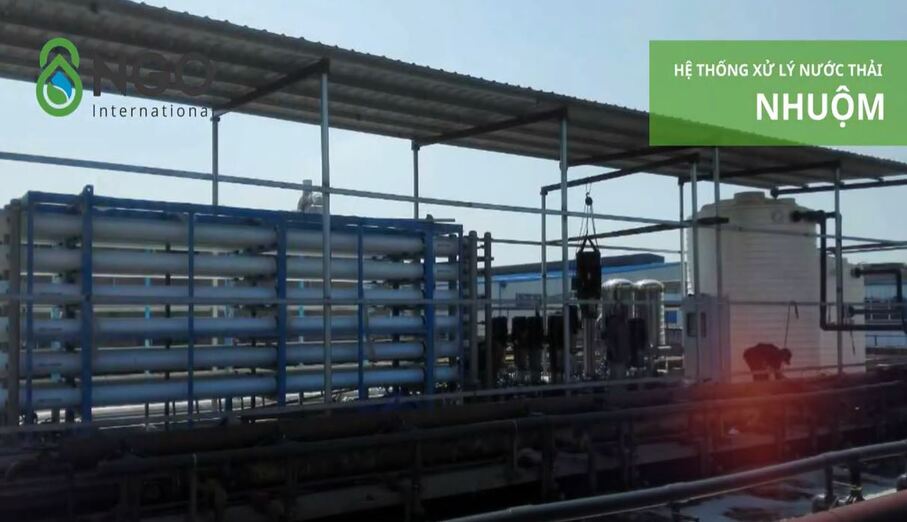
MBR eliminates the secondary settling tank thanks to membrane filtration, produces clear and stable effluent, and uses smaller tanks that can be installed underground in confined spaces; a detailed comparison is given in the article on MBR membrane wastewater treatment technology. The biofilm group, including MBBR with moving media and the SmartB solution developed by NGO, keeps the biomass attached to the media, so it depends less on sludge settling and copes better with load when the flow fluctuates.
What every urban scheme has in common is odour containment, ventilation of the underground pit and automation so that one person can monitor many sites.
Decentralised domestic wastewater treatment in Hanoi
Hanoi is where NGO International is headquartered and where it built the underground station described above. High building density, many existing structures and residential areas close to factories mean that construction often takes place in tight spaces, with time, noise and safety kept under strict control.
Facilities outside industrial parks discharge domestic wastewater under QCVN 14:2025/BTNMT, in the column corresponding to the receiving water body; factories inside industrial parks follow the connection limits of the park’s centralised plant. Many inner-city areas still use combined sewers for stormwater and wastewater, so stormwater on the premises needs to be separated from the wastewater line running to the station, and the discharge point needs a suitable elevation and a non-return valve so that the sewer does not back up during heavy rain. Confirming the discharge point and the receiving authority before design avoids having to modify the system later.
Outside Hanoi, NGO International builds decentralised domestic wastewater treatment stations for buildings, resorts and factory premises in the provinces below, and provides operation management of the stations after handover. Quang Ninh and Nghe An have many coastal tourism and service developments that need compact, odour-tight stations.
Where we work: decentralised domestic wastewater treatment
Northern Vietnam: Hanoi, Quang Ninh
Central Vietnam: Nghe An
Southern Vietnam: Ho Chi Minh City
Why choose a contractor with real-world experience?
A decentralised underground station is hard to inspect visually once it has been backfilled, so construction quality matters more than any specification sheet. Before backfilling, the project owner should require acceptance testing of the waterproofing and checks on tank anti-settlement measures and on the layout of access covers and ventilation, and should agree on who will carry out periodic maintenance.
Experience of working in urban areas also counts: obtaining construction permits, coordinating with the building management or the residential community, and dealing with surprises when excavation runs into existing underground infrastructure. These tasks rarely appear in tender documents, but they determine the schedule.
Frequently asked questions
NGO International, a Hanoi-based company, has built an underground domestic wastewater treatment station for Carlsberg Vietnam in Hanoi, and supplied MBR membranes and five years of operation support for a factory’s wastewater treatment plant.
NGO takes on the construction and operation management of decentralised stations in Quang Ninh, Nghe An and Ho Chi Minh City, in addition to its projects in Hanoi.
It is a station whose tanks and equipment are installed underground beneath the site, with only a small station house or access covers above ground, which saves space.
Wastewater is treated close to where it is generated by several small stations, without the need for a long collection network. In return, there are more points to monitor.
Biological treatment with modified activated sludge (AO, AAO), MBR or biofilm technologies such as MBBR, together with settling or filtration and disinfection. The choice depends on the available space and the effluent requirements.
Ammonium and total nitrogen. Ammonium needs nitrification in an aerobic tank with a sufficiently long sludge age, while total nitrogen also requires an anoxic stage for denitrification.
Facilities outside industrial parks apply QCVN 14:2025/BTNMT in the column corresponding to the receiving water body; factories inside industrial parks follow the connection limits of the park’s centralised plant.
Underground stations are designed to be sealed, so odour mainly arises at the vent pipes and when covers are opened for maintenance. Vent pipes should be placed high and away from neighbours’ windows, and the exhaust air can be treated when the station is located right next to a residential area.
Conclusion
Underground stations and the decentralised model make it possible to treat domestic wastewater at each site without taking up land, which is especially valuable in urban areas. In return, construction quality must be controlled from the outset, because an underground system is very difficult to repair once it has been backfilled.
Based in Hanoi, NGO International has built an underground domestic wastewater treatment station for Carlsberg Vietnam in Hanoi and provided five years of operation support for a factory’s MBR membrane system. Buildings or facilities looking for an on-site treatment solution can book a survey of the station location with NGO’s engineering team.
Contact NGO International