Tiếng Việt
 中文 (中国)

BioPM (Biofilter for production & manufacturing) – A pioneering biofilter solution for organic industrial wastewater
BioPM was developed specifically to put an end to the “headaches” of treating high-concentration wastewater in industry. Instead of investing in a complex system, running it under strict control and worrying about the amount of sludge produced, businesses can now rely on modern biofilm technology:
- Outstanding performance: High treatment capacity lets the effluent quickly reach Column A or a quality suitable for reuse, even when the incoming pollutant concentration fluctuates widely.
- Simple operation: No need to tightly control viscosity or microbial density, and the sludge recirculation and settling steps are eliminated entirely.
- Savings in cost & labour: Minimal initial investment and day-to-day operating costs, “freeing” the operating team from a host of complex responsibilities.
- Sustainable & safe: Fully meets QCVN 40:2025/BTNMT (in Vietnamese), enhancing the company’s reputation and protecting the environment over the long term.
1. Who is BioPM suitable for?
BioPM is especially effective for processing and manufacturing enterprises whose wastewater has a high content of plant- and animal-based organic matter (usually BOD/COD ≥0.2), for example:
- Food and seafood processing enterprises
- Beverage, beer and alcohol manufacturers
- Coffee producers
- Industrial parks and enterprises with large workforces
- Urban domestic wastewater treatment systems,…
2. What added value does BioPM bring to customers?
- Construction costs are 50% lower thanks to the very small tank volume
- Very low sludge treatment costs, because far less sludge is produced than with the suspended-growth activated sludge method; some completed projects do not even need a sludge holding tank because there is so little sludge, which saves operating costs
- Overcomes the difficulty of unbalanced incoming pollutant concentrations (COD/TN, BOD/TN)
- Low power consumption thanks to a design optimised for flow and dynamics
- Thorough removal of TN from the wastewater thanks to the anoxic biofilm formed within the filter layer
- Eliminates foaming in the effluent when there are large amounts of surfactants (for example detergents and soap), with better surfactant removal than the activated sludge method and MBR membrane filtration
- Withstands inflow fluctuations of up to 20%-30% in capacity or concentration
- Creates an environment that naturally selects microorganisms, retaining those with a high sludge age and eliminating fast-growing, poorly settling microorganisms that would otherwise be discharged to the environment
- Improves the air transfer efficiency of the distribution system from the wastewater to the microorganisms, because the air flows in a zigzag path rather than a straight line.
3. How does BioPM work?
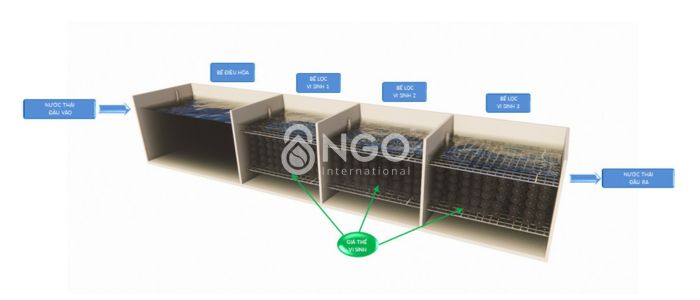
- BioPM treats pollutants through biofilter tanks, which include some or all of the filtration steps: anaerobic filtration, anoxic filtration and aerobic filtration. The water flows from the bottom upward. After passing through these filter layers, organic pollutants and nutrients are thoroughly treated to meet Column A – QCVN40:2025/BTNMT.
- Because it works by filtration, the treatment system does not require a sludge settling tank before discharge to the environment. The sludge is retained in the filter layers instead of being suspended in the wastewater, so water quality remains stable even when the sludge cannot form granules or settle well, which makes operation less complex than with current activated sludge technology.
- The difference in applying BioPM to different types of production wastewater lies in the pretreatment step (primary treatment); the pretreatment steps are designed to suit the specific properties of the wastewater.
4. What volume does the treatment system need?
The volume of a BioPM system is calculated and designed by NGO International based on the following key factors:
- Discharge scale (Q): Daily wastewater flow rate (m³/day).
- Discharge pattern: Continuous, hourly or seasonal.
- Influent characteristics: Concentrations of COD, BOD, TN, TP, pH and toxic substances (if any).
- Required effluent quality: Discharge standard (Column A, B of QCVN 40) or reuse standard.
- Customer’s available space: The design is optimised for the actual site layout.
Typically, the total volume of a BioPM system ranges from about 1.2Q – 2Q. For wastewater with very high pollutant concentrations (for example COD ≥ 10,000 mg/L), a longer retention time may be needed. We can design vertical filter modules to increase the microbial density per unit of area, effectively saving construction space.
5. How does BioPM differ from other technologies?
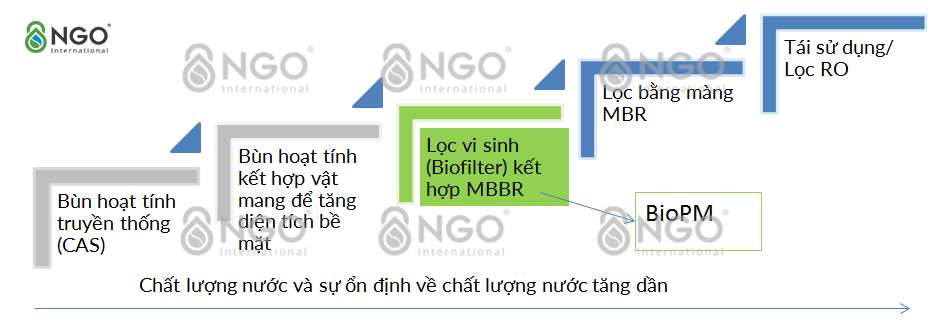
| Feature | Conventional Activated Sludge | BioPM | MBR Membrane Bioreactor |
| Mechanism | Microorganisms suspended in the water. | Microorganisms attached to a carrier, forming a biofilm. | Suspended microorganisms combined with a membrane for phase separation. |
| Waste Sludge | A lot, requiring complex treatment. | Very little, stable. | Less than activated sludge, but still needs management. |
| Footprint | Large, needs a settling tank. | Compact, saves ~50%. | Compact, but membrane costs are high. |
| Operation | Complex, requires control of SVI, F/M and sludge recirculation. | Simple, highly automated, little supervision. | Requires control of membrane clogging and periodic membrane cleaning. |
| Stability | Easily affected by fluctuations, sludge bulking and poor settling. | Very high, withstands shock loads well. | Stable, but sensitive to certain membrane-fouling substances. |
| Nitrogen Removal | Needs a separate anoxic tank and nitrate recirculation. | Very effective thanks to natural anoxic zones. | Effective, similar to activated sludge with an anoxic tank. |
| Investment Cost | Low to medium. | Medium to high (depending on scale). | High (due to membrane costs). |
| Operating Cost | Medium (sludge treatment, labour). | Low (little sludge, little labour, saves electricity). | Medium to high (membrane replacement, membrane cleaning, electricity). |
6. Featured project
- Project: A large-scale agricultural product processing plant in the Mekong Delta.
- Challenge: Influent COD fluctuated between 3,500 and 6,000 mg/L and BOD between 2,000 and 3,500 mg/L, with frequent operating problems in the old activated sludge system.
- Solution: NGO International implemented a BioPM system with a capacity of 800 m³/day.
- Results:
- Effluent COD stable at < 80 mg/L and BOD < 30 mg/L (meeting QCVN 40:2025/BTNMT, Column A).
- 60% smaller construction footprint than an improved activated sludge option.
- Sludge treatment costs down 85%.
- 25% saving on operating electricity costs.
- The system runs automatically and needs only one part-time staff member to supervise it.
“Since switching to NGO International’s BioPM system, our effluent consistently meets Column A, operating costs have dropped sharply, and above all we no longer worry about sludge treatment. NGO’s engineering team is very professional and dedicated.” – Mr. N.V.T, Food Plant Director
7. Frequently asked questions
The initial investment cost of BioPM can be equal to or slightly higher than that of a simple conventional activated sludge system, but lower than MBR. However, in terms of total life-cycle cost (including construction, operation, maintenance and sludge treatment), BioPM usually delivers outstanding economic efficiency.
Depending on scale and complexity, construction can take from 2 to 6 months. NGO International is committed to optimising the schedule while ensuring quality.
Absolutely. NGO International will survey the properties of your wastewater in detail and design suitable pretreatment steps (oil separation, preliminary colour removal…) before the BioPM system to ensure optimal performance.
Yes. BioPM is designed in a modular form, allowing easy expansion and capacity upgrades as your production demand grows.
Absolutely! The quality of water treated with BioPM is usually very good, and polishing steps (for example sand filtration and disinfection) can be added so the water can be reused for many purposes such as irrigation, cleaning and cooling, helping the business save on supply water costs.
See more:
https://ngoenvironment.com/en/wastewater-treatment.html
https://shopngoenvironment.com/product-category/san-pham-cong-nghiep/
Businesses interested in an organic industrial wastewater treatment solution are welcome to contact NGO at +84 24 7300 0890 or by email at office@8ngo.com for direct consultation.

Talk to an NGO engineer
Free survey and consultation. Send us your wastewater type (industrial or domestic), flow rate (m³/day), influent analysis results if available and required effluent quality; an NGO engineer will propose a suitable technology and a realistic quotation.
Offices in Hanoi and Ho Chi Minh City · +84 24 7300 0890 · office@8ngo.com
***Please read the Terms of Use – Copyright carefully before copying or quoting any content or images from this website.
This website is copyrighted by NGO International Co., Ltd. Any use or reproduction of part or all of its content in any form is strictly prohibited without our express written permission.
See more: MBR Membrane Technology — works effectively together with BioPM