Tiếng Việt
 中文 (中国)

On-site wastewater reuse usually comes down to two questions: is it costly to collect water from many points, and is the treated water clean enough to be reused? A decentralised station answers the first by treating the wastewater right next to where it is generated; the second is answered by testing the effluent. NGO International Co., Ltd (NGO International), a water and wastewater treatment company headquartered in Hanoi, has delivered a recycling station for domestic and production wastewater based on this model, with the effluent tested against the regulation for irrigation water. With NGO’s solution, up to 90% of the treated water can be reused.
Overview of decentralised wastewater reuse
Domestic wastewater and some light production wastewater are usually generated at many small points: worker housing, canteens, toilets, washing areas. Instead of collecting it at one large plant, the decentralised model treats each cluster on site, then returns the water for reuse in landscape irrigation, floor washing, sanitary use or as make-up water for cooling systems.
What determines success or failure is the water quality required for each use. Water for irrigation or floor washing can accept a moderate level of treatment but must be disinfected; make-up water for cooling or boilers needs an additional step to reduce hardness and conductivity. Small, scattered stations are also harder to monitor than one centralised plant, so the design needs to be simple and automated, with a way to monitor quality periodically or remotely.
When assessing options, consider the volume of water generated at each point, the intended reuse, the reference regulation, the space for the tanks and operating costs. For example, Column B1 of QCVN 08-MT:2015/BTNMT is the surface water quality level for irrigation or uses with similar requirements, so it is often used as the reference when treated water is reused for these purposes.
NGO International’s capabilities in wastewater reuse
Water reuse and recycling is a goal NGO International sets in its wastewater treatment projects across many industries: food and beverage, textile dyeing, plating and electronic components. With the decentralised model, the scope of work ranges from laying out the tank clusters, construction, and installing equipment and pipework to sampling and testing the effluent.
When the intended reuse requires higher quality, the configuration adds membrane filtration or ion exchange, as at the wastewater reuse station for electronic component plating. In the electronic components industry, one of NGO’s clients has set a target of reusing at least 50% of its water. Systems that are already running but not yet stable can be reviewed through our operation consulting service.
Featured projects by NGO International
The location and project owner are not disclosed; the content below is based on the video at the top of this article, the test report and the list on the featured projects page.
Decentralised recycling station for domestic and production wastewater
| Water source | Domestic and production |
|---|---|
| Model | Decentralised, multi-compartment tank cluster |
| NGO’s scope | Construction, installation, operation, testing |
| Year | Operation and testing in 2024 |
- The challenge
The facility needed to treat its domestic and production wastewater right on site, to a quality good enough for the water to be reused.
- NGO’s solution
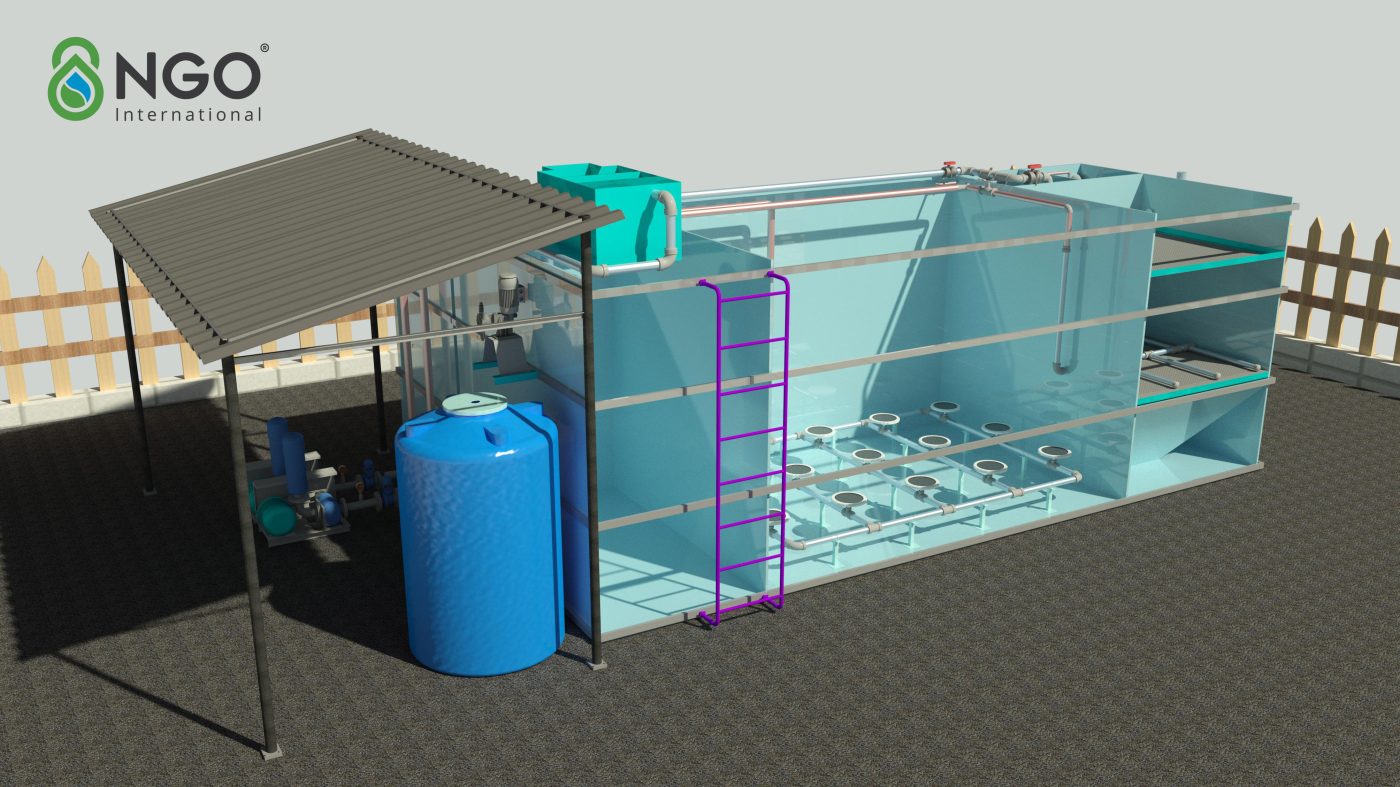
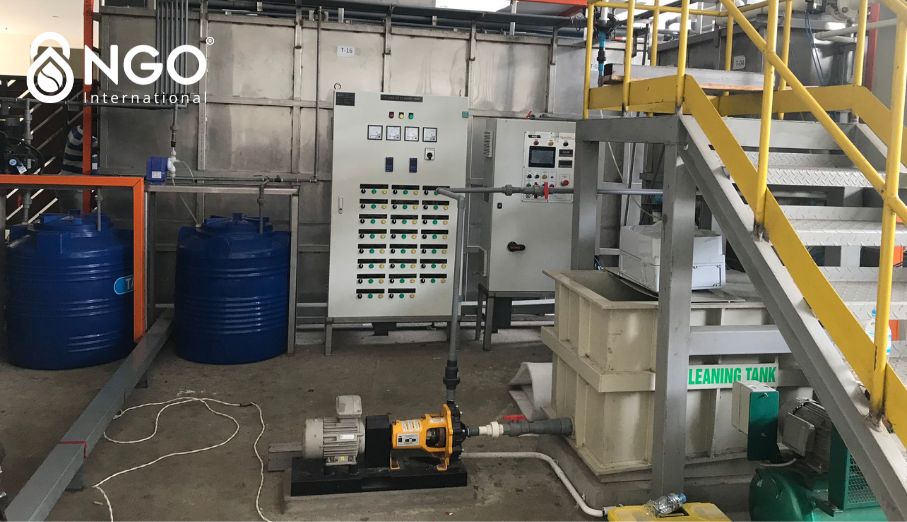
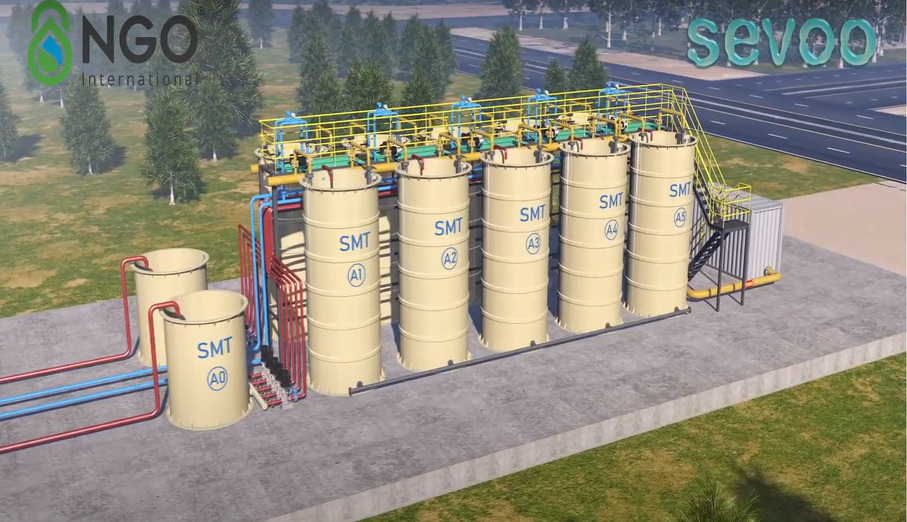
The station consists of a cluster of multi-compartment reinforced concrete tanks, an aerobic biological tank with uniform aeration from the tank bottom, and an equipment and pipework area laid out compactly within a mesh-fenced enclosure. The electrical panel has a control screen.
- NGO’s role
NGO International carried out the stages of tank construction, installation of the equipment and electrical panel, finishing, operation, and sampling and testing of the effluent.
- Results / value delivered
The test report compares pH, COD, total nitrogen, phosphate and TSS against QCVN 08-MT:2015/BTNMT, Column B1; all parameters that have limits in the regulation were met. The water sample taken on site was clear.
Wastewater treatment technologies commonly used for reuse stations
The foundation of a reuse station is aerobic biological treatment – activated sludge, MBBR or MBR – after screening and primary settling. MBR is especially suitable when clear, stable effluent is needed, because the membrane retains almost all suspended sludge; see also our analysis of MBR membrane technology. MBR membranes also reduce the treatment tank area by up to 50% compared with conventional technology.
Biological treatment is followed by filtration (sand, activated carbon) and disinfection with chlorine or UV; water for irrigation or floor washing usually stops here. If the water is supplied back to cooling or production lines, membrane filtration, RO or ion exchange is also needed to reduce conductivity and hardness.
The general principle is to define the intended reuse first and only then choose the treatment stages, so as not to over-invest in water used only for irrigation, nor to leave out treatment stages for water used in production.
Decentralised wastewater reuse in Vietnam
The decentralised model suits places where wastewater is generated at many points far apart, where supply water is expensive or water sources are seasonally scarce, and where a sensitive receiving water body makes reducing discharge worthwhile. Saltwater intrusion in the Mekong Delta or dry-season water shortages in the Central Highlands can disrupt production, so many businesses there plan for reuse from the design stage.
For facilities in an industrial park, discuss on-site water reuse and the connection conditions for the remaining discharge with the park management board in advance. For projects near residential areas, distance, odour and noise control of the station must be considered from the site layout stage. NGO has offices in both Hanoi and Ho Chi Minh City, so we can survey and support station operation for facilities in both regions.
NGO International undertakes surveys, construction and operation of decentralised wastewater reuse stations for facilities in the provinces below. Long An is affected by dry-season saltwater intrusion, so water reuse is considered early; in Central Vietnam, Thanh Hoa and Nghe An have many new industrial parks, where reusing water reduces both water intake and discharge.
Where we work: wastewater reuse stations
Central Vietnam: Thanh Hoa, Nghe An
Southern Vietnam: Long An (now part of Tay Ninh), Tay Ninh
Why choose a provider with hands-on experience?
Water reuse differs from treatment for discharge in that the consequences of mistakes go straight to production or to the health of people in contact with the water. The design documents should therefore clearly state the assumed reuse purpose, which parameters are tested, the sampling frequency and who is responsible when water quality declines.
For decentralised stations, experience operating multiple points also matters: equipment should be simple and easy to replace, with clear instructions for non-specialist staff. A station that requires an engineer on site every day is hard to sustain at small scale.
Frequently asked questions
Yes, depending on the level of treatment. Water that has gone through biological treatment, filtration and disinfection is commonly used for landscape irrigation, floor washing and sanitary use; for cooling or production, membrane filtration, RO or ion exchange is also needed.
NGO International has built, installed, operated and tested a decentralised recycling station for domestic and production wastewater; the effluent was compared against QCVN 08-MT:2015/BTNMT, Column B1.
Because the water is treated and reused right where it is generated, both the wastewater collection pipes and the pipes carrying reused water over long distances are avoided. In return, each point needs its own sampling and monitoring schedule.
NGO undertakes surveys and construction of reuse stations in Thanh Hoa and Nghe An in Central Vietnam; Long An (now part of Tay Ninh) and Tay Ninh in Southern Vietnam; and other localities as required by the project.
It is the surface water quality level for irrigation or uses with similar requirements. The version that currently replaces it is QCVN 08:2023/BTNMT.
It depends on the intended reuse. For the station above, the test report covers pH, COD, total nitrogen, phosphate and TSS, compared against Column B1. Water supplied back to cooling or production usually also needs hardness and electrical conductivity; water for irrigation or washing also needs microbiological parameters.
A decentralised station should be designed so that non-specialist staff can monitor it via an electrical panel with a display screen, while technicians carry out periodic checks. The level of automation and the frequency of checks should be agreed from the design stage.
Conclusion
Decentralised wastewater reuse works well when the intended reuse is defined in advance and water quality is tested periodically. Treating close to the source avoids collection costs, while the level of treatment is chosen for each purpose instead of applying one standard across the board.
NGO International has delivered a station of this type, from tank construction and installation to effluent testing against QCVN 08-MT:2015/BTNMT. Facilities with many wastewater generation points can talk to NGO about the intended reuse before choosing a configuration.
Contact NGO International