Tiếng Việt
 中文 (中国)
With textile dyeing wastewater, meeting the COD limit is not the hardest part; colour is. Reactive dyes dissolve readily, so they remain after both coagulation and biological treatment, while adding more decolourising chemicals drives up cost and sludge. NGO International Co., Ltd (NGO International), a company that designs, builds and provides operation consulting for wastewater treatment, tackles this problem in two ways: a decolourisation solution that uses no flocculating chemicals, and adjusting the operation of systems already in service. The second approach has been applied at a textile dyeing industrial cluster in Ninh Binh (former Nam Dinh and Ha Nam provinces).
Overview of textile dyeing wastewater treatment
Each tonne of fabric can consume 120 to 300 m³ of water, and the wastewater comes from many process stages with very different characteristics. Desizing gives high COD from starch and PVA; scouring and bleaching give high alkalinity; dyeing gives intense colour along with electrolyte salts and auxiliaries; washing and finishing carry surfactants. The wastewater is usually hot, its pH can exceed 9, and it contains metals from the dyes.
Disperse and vat dyes exist as insoluble particles, so coagulation removes most of them, whereas reactive, acid and direct dyes dissolve readily and resist biodegradation, so they often remain after both steps. Order-based production means colour, pH and concentration change constantly, which makes accurate chemical dosing at the coagulation or Fenton stage difficult. High salinity also inhibits microorganisms and hinders water reuse.
The technology is therefore chosen according to the main dye type, the range of fluctuation in colour and COD, salinity, temperature, available land, the discharge regulation and reuse targets. A factory dyeing with disperse dyes and one dyeing with reactive dyes can hardly share the same process scheme.
NGO International’s capabilities in textile dyeing wastewater treatment
In textile dyeing wastewater treatment, NGO International takes on three types of work for factories and industrial clusters: designing and building new plants; upgrading plants that perform poorly; and operation consulting and adjustment when the problem lies in how the system is run. The technologies we apply include electrochemical treatment (electrocoagulation), Fenton, DAF flotation combined with IC or CSTR anaerobic treatment, and MBR when about half of the treated water needs to be recirculated. Our solutions for the textile dyeing industry page describes these approaches.
What is distinctive in this field is a decolourisation solution that uses neither flocculating chemicals nor decolourising chemicals. The solution is designed to remove more than 95% of all types of colour, including colour from reactive dyes, generates little sludge and delivers results from the very first day of operation; its decolourisation performance does not depend on the biological system or on weather fluctuations. The principle is explained in the article on colour treatment of textile dyeing and industrial washing wastewater.
Featured projects by NGO International
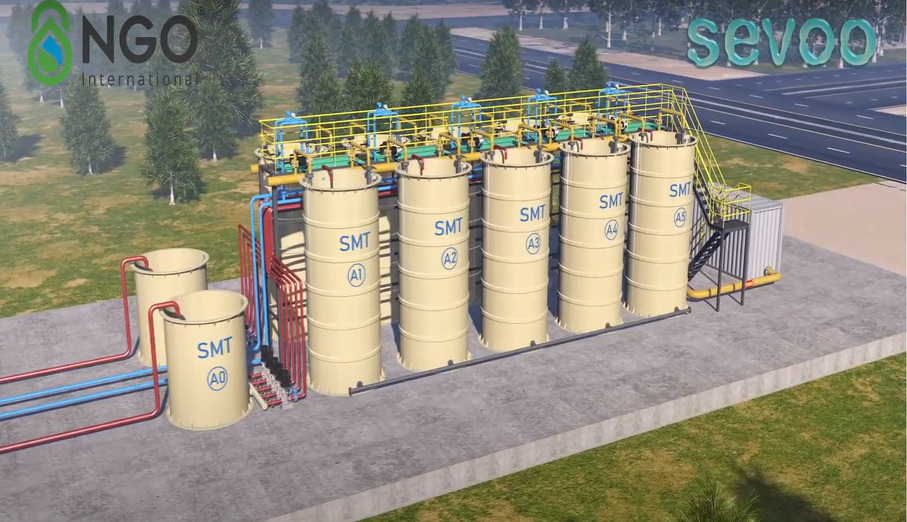
The three cases below are an operating system whose operation was adjusted, a decolourisation plant, and a garment factory project designed and built by NGO. The video at the top of this article shows the decolourisation plant, with its reaction tanks and water samples before and after treatment. Company names are withheld under our client confidentiality policy.
Optimising the operation of a textile dyeing industrial cluster wastewater treatment system in Ninh Binh
| Location | Ninh Binh (former Nam Dinh and Ha Nam provinces) |
|---|---|
| Industry | Textile dyeing |
| NGO’s scope | Consulting on and adjusting the operating procedure |
| Year | 2025 |
- The challenge
The cluster’s treatment system was already in operation but needed to stabilise water quality and reduce the consumption of decolourising chemicals.
- NGO’s solution
The operating procedure was changed on the existing system, with no new works built. Our operation consulting service typically involves surveying the current condition and operating records, identifying underperforming stages, then adjusting chemical doses and parameters to the actual load.
- NGO’s role
NGO International was responsible for consulting on and adjusting the operation of the wastewater treatment system at the textile dyeing industrial cluster in Ninh Binh; the work was carried out directly at the plant in 2025.
- Results / value delivered
Treated water quality became stable and improved, and decolourising chemical consumption fell without investment in any new facilities.
Textile dyeing wastewater decolourisation plant without flocculating chemicals
| Industry | Textile dyeing |
|---|---|
| Colour removal efficiency | Over 95% by design, including colour from reactive dyes |
| Chemicals | No flocculants or decolourising agents |
- The challenge
Dyeing wastewater with high colour, including colour from reactive dyes, needed to be decolourised without increasing chemical sludge as conventional coagulation does.
- NGO’s solution
The plant uses a decolourisation solution that is independent of the biological system, with no flocculating or decolourising chemicals added. Heavy metals, oil and grease, and most of the COD are also treated at this same stage.
- NGO’s role
NGO International supplied the decolourisation solution for the plant.
- Results / value delivered
The solution is designed to remove more than 95% of colour, with clearly visible results from the first day of operation. It generates less sludge than chemical decolourisation.
Wastewater treatment system for a garment factory
| Industry | Textiles and garments (garment manufacturing) |
|---|---|
| NGO’s scope | Design, construction, operation support |
| Operating period | 3 years (according to client feedback) |
- The challenge
The factory needed a new wastewater treatment system, with a single contractor responsible for both design and construction.
- NGO’s solution
Design and construction tailored to the wastewater characteristics of the garment factory.
- NGO’s role
Design-and-build contractor. When some technical issues arose at the plant during implementation and operation, NGO’s technical team was on hand promptly to advise and resolve them.
- Results / value delivered
According to the factory’s feedback, the system has been operating for three years with consistently assured water quality. The feedback is published in the “What our clients say” section of our Projects page (in Vietnamese).
Wastewater treatment technologies commonly used in the textile dyeing industry
Pretreatment includes cooling, pH adjustment, removal of fibres and oil and grease, followed by flow equalisation. Coagulation–flocculation with PAC or alum can remove disperse dye colour and suspended solids, but has little effect on reactive dye colour and generates a lot of chemical sludge, so it is usually just one step in the treatment train.
To break the colour-bearing bonds and reduce refractory COD, factories use advanced oxidation such as Fenton or ozone. Fenton works at acidic pH and produces iron sludge, so both chemical costs and sludge treatment costs must be taken into account. Electrocoagulation generates the coagulant directly in the tank from the electrodes, significantly reducing the amount of chemicals that must be added.
Biological treatment is still needed for the remaining organics. For high-COD wastewater, IC or CSTR anaerobic treatment reduces the load ahead of the aerobic stage; whether decolourisation comes before or after the biological stage depends on the dye type and the toxicity of the wastewater. Where reuse is the goal, MBR and UF/RO membrane filtration bring the water to reusable quality, but RO retains salts and therefore produces a concentrate stream that needs separate treatment.
Textile dyeing wastewater treatment in Ninh Binh (former Nam Dinh and Ha Nam provinces)
Today’s Ninh Binh province comprises the former Ninh Binh, Nam Dinh and Ha Nam provinces. Nam Dinh has long been a textile and garment centre of Northern Vietnam, with many small and medium-sized textile dyeing facilities in industrial clusters and craft villages.
Here, NGO International took part in adjusting the operation of the wastewater treatment system of a textile dyeing industrial cluster (the project above). Also in the province, we implemented the centralised wastewater treatment plant for Yen Bang Industrial Cluster in former Nam Dinh; see the article on industrial cluster wastewater treatment in Nam Dinh.
Beyond Ninh Binh, NGO International takes on both new construction and upgrades of textile dyeing wastewater treatment systems for factories in the provinces below. Hung Yen and Hai Duong have many textile and garment factories in the industrial parks east of Hanoi; in Southern Vietnam, textile dyeing is concentrated around zones such as Nhon Trach (Dong Nai) and Phuoc Dong (Tay Ninh).
Where we work: textile dyeing wastewater treatment
Northern Vietnam: Nam Dinh (now part of Ninh Binh), Hung Yen, Hai Duong (now part of Hai Phong)
Southern Vietnam: Binh Duong (now part of Ho Chi Minh City), Dong Nai, Tay Ninh
In a textile dyeing industrial cluster, wastewater from many facilities flows to one shared plant, so the plant is only stable when each facility stays within the connection limits. Controlling the connected wastewater, adjusting chemical doses to the actual load and having an incident response procedure are the plant’s daily work, not just a matter for the design stage.
On regulations, from 1 September 2025 the separate technical regulation for textile dyeing wastewater was merged into QCVN 40:2025/BTNMT. Operating textile dyeing facilities whose environmental records were approved before that date have a transition period until the end of 2031; new or expanded projects must comply immediately.
Why choose a contractor with hands-on experience?
Textile dyeing wastewater can easily make a design that is correct on paper go wrong in operation, because average figures do not reflect dark-shade batches or constant colour changes. Before signing a contract, a factory should ask the contractor to state three things clearly: which dye types they have treated, test results on the factory’s own water samples, and the expected chemical cost and sludge volume per cubic metre.
A criterion that is often overlooked is the ability to make adjustments after handover. When orders change, the wastewater changes; an experienced contractor leaves behind an adjustable operating procedure, trains staff and monitors the initial period instead of stopping at acceptance.
Frequently asked questions
NGO International has taken part in adjusting the operation of the wastewater treatment system of a textile dyeing industrial cluster in Ninh Binh province (the area of former Nam Dinh and Ha Nam provinces), and has also implemented the centralised wastewater treatment plant for Yen Bang Industrial Cluster in former Nam Dinh.
Yes. In addition to operation consulting, NGO supplies decolourisation solutions for textile dyeing plants and has been the design-and-build contractor for the wastewater treatment system of a garment factory.
Reactive dyes dissolve readily and resist biodegradation, so chemical coagulation and biological treatment each remove only part of the colour. Advanced oxidation or electrocoagulation is usually required.
No, it is not required. The decolourisation solution described above uses no flocculating or decolourising chemicals, is designed to remove more than 95% of colour and generates less sludge.
Yes, once colour has been removed and salinity reduced sufficiently. With MBR, the recirculation target is about 50% of the treated water; the actual figure depends on the water quality required by the process stage where it is reused.
Besides Ninh Binh (former Nam Dinh and Ha Nam provinces), NGO takes on textile dyeing projects in Hung Yen and Hai Duong (now part of Hai Phong) in Northern Vietnam, and in former Binh Duong province (now part of Ho Chi Minh City), Dong Nai and Tay Ninh in Southern Vietnam. Site surveys and sampling are handled by the nearest office (Hanoi or Ho Chi Minh City).
Operational optimisation keeps the existing works unchanged and only adjusts the procedure, chemical doses and parameters to the actual load. An upgrade is considered when the works can no longer cope, for example when a treatment stage is missing or a tank is overloaded.
Check how the system is operated before changing the technology: are chemical doses matched to the actual load, and are the coagulation and decolourisation steps running at the correct parameters? At a textile dyeing industrial cluster in Ninh Binh, adjusting the procedure on the existing system reduced decolourising chemical consumption.
Conclusion
Textile dyeing wastewater shows clearly why a standard process scheme should not simply be copied: dye types, salinity and temperature vary from factory to factory, while chemicals and sludge add up in monthly costs. A durable solution is one that removes colour consistently, produces little sludge and comes with an adjustable operating procedure.
NGO International has both a decolourisation solution that uses no flocculating chemicals and experience in adjusting operations at a textile dyeing industrial cluster in Ninh Binh. Factories or industrial clusters struggling with colour or chemical costs can send their information to NGO (main dye type, flow rate, current chemical costs) for an assessment.
Contact NGO International